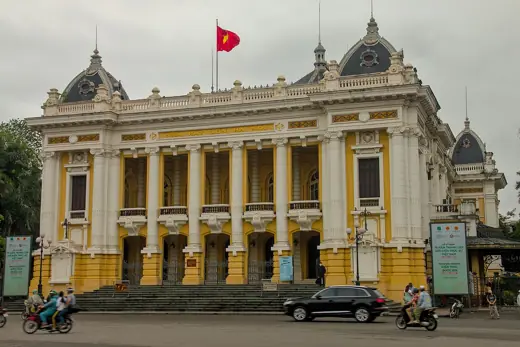
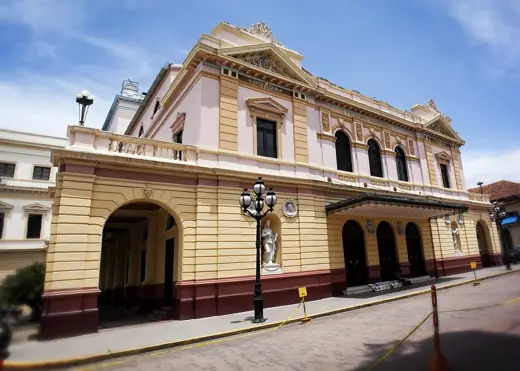
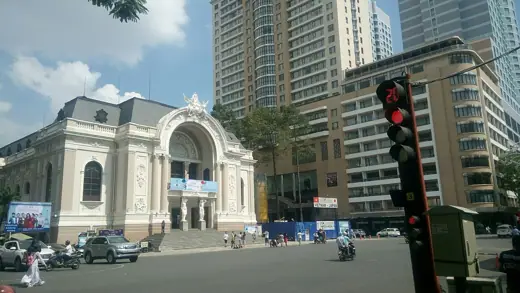
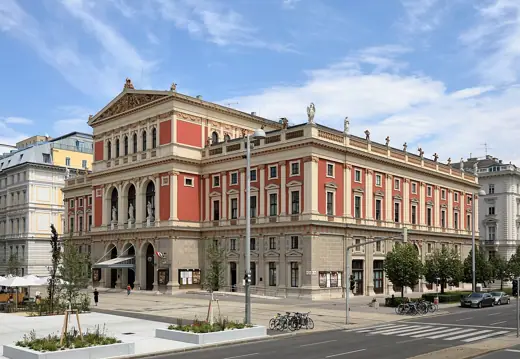
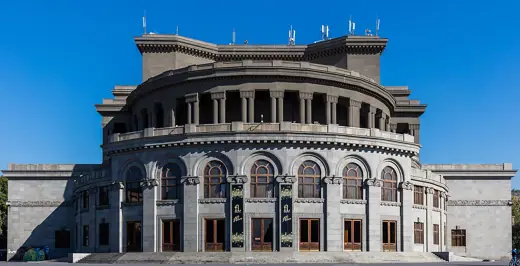
1/8 · Exterior · Hanoi (Vietnam) - Opera housePhoto: Benjamin Smith · CC BY-SA 4.0 · source2/8 · ExteriorPhoto: lumoplank · CC0 · source3/8 · Exterior · Hanoi Opera House, 1901-11 (1)Photo: Richard Mortel from Riyadh, Saudi Arabia · CC BY 2.0 · source4/8 · Exterior · Hanoi Opera House, 1901-11 (2)Photo: Richard Mortel from Riyadh, Saudi Arabia · CC BY 2.0 · source5/8 · Interior · The main stage of Hanoi Opera HousePhoto: Quenhitran · CC BY-SA 4.0 · source6/8 · Interior · Stage of the Hanoi OperaPhoto: M koetteritz · CC BY 3.0 · source7/8 · ElevationPhoto: Francois Lagisquet · Public domain · source8/8 · ElevationPhoto: Harley and Broyer · Public domain · source
Key featuresNeoclassical with French Renaissance elements, modelled on the Palais Garnier but smaller, in locally suited materials.
About the building
The Hanoi Opera House anchors August Revolution Square at the top of Tràng Tiền street. The French colonial administration built it as the city's Municipal Theatre, one of three opera houses in French Indochina with those of Haiphong and Saigon. Work ran from June 1901 to December 1911. The French architect Broyer and Victorin Harlay, Chief Inspector of Public Buildings, conceived the design, and another French architect, François Lagisquet, completed it with Harlay. Modelled on the Palais Garnier in Paris but smaller, it is Neoclassical with French Renaissance touches, built in materials better suited to local conditions. The theatre had 870 seats. In September 1945 the Viet Minh leadership proclaimed the Democratic Republic of Vietnam's independence from its balcony. A two-year restoration from 1995 employed 100 workers, overseen by Hồ Thiệu Trị, the French-Vietnamese architect who drew up the plan.
The Hanoi Opera House (French: Opéra de Hanoï), or the Grand Opera House (French: Grand Opéra, Vietnamese: Nhà hát Lớn Hà Nội) is an opera house in central Hanoi, Vietnam. It is located at August Revolution Square, anchoring the head of Tràng Tiền street.
One of Hanoi's most prominent architectural landmarks, the Hanoi Opera House was modeled on the Palais Garnier, the older of Paris's two opera houses, but with a smaller scale and using materials that are more suitable to the local environment. Built in the Neoclassical style with French Renaissance elements, the design was initially conceived by French architect Broyer and Chief Inspector of Public Buildings Victorin Harlay, and later fully realized by French architect François Lagisquet in collaboration with Harlay. Construction started in June 1901 and finished a decade later in December 1911.
A source of great municipal pride, the theater became the heart of French cultural life in Hanoi. The colonial government subsidized an opera company to sing each winter for local French residents, at the cost of the native taxpayer. However, the 870-seat theater stood mostly empty for the rest of the year, with only the occasional military band or touring soloist making brief appearances.