Portrait: Ausschnitt aus Kupferstich von G. Frank sc. · Public domain · source
About Musikverein
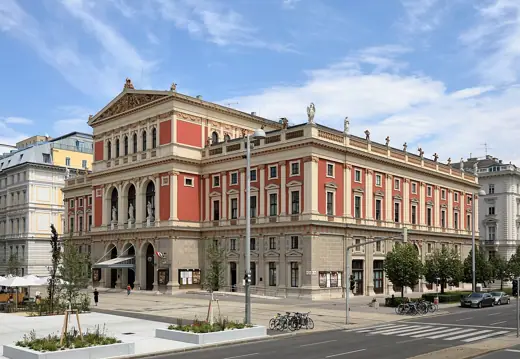
The Wiener Musikverein (German: [ˌviːnɐ muˈziːkfɐ̯ˌaɪn] or German: [ˌviːnɐ muˈziːkfəˌʁaɪn]; German for 'Viennese Music Association'), commonly shortened to Musikverein, is a concert hall in Vienna, Austria, which is located in the Innere Stadt district. During the 1863 construction of the Vienna Ring Road (Ringstraße) a piece of land for a new concert hall was granted to the Society of Friends of Music in Vienna by Emperor Franz Joseph I of Austria. Designed by Danish-born architect Theophil Hansen, the concert hall has housed the Vienna Philharmonic since its opening in 1870.
The Musikverein's main entrance is situated on Musikvereinsplatz, between Karlsplatz and Bösendorferstraße. The building is located behind the Hotel Imperial that fronts on Kärntner Ring, which is part of the Vienna Ring Road (Ringstraße).
The plans were designed by Danish architect Theophil Hansen in the Neoclassical style of an ancient Greek temple, including a concert hall and a smaller chamber music hall. The building was inaugurated on 6 January 1870. A major donor was Nikolaus Dumba, an industrialist and liberal politician of Aromanian Greek - Albanian (Voskopoja) descent, whose name was given by the Austrian government to a small street (Dumbastraße) near the Musikverein. Another important donor, also of Aromanian descent, was Simon Sinas.