




Culture & sport · Modernism
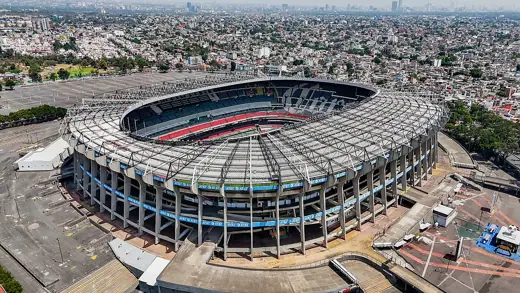
Estadio Azteca

Key featuresConcrete bowl ringed by a frame of raking columns, host of the 1970, 1986 and 2026 World Cups.
About the building
Known officially as Estadio Banorte for sponsorship, Estadio Azteca is a football stadium in Coyoacán, Mexico City. Designed by Rafael Mijares Alcérreca and Pedro Ramírez Vázquez, it broke ground in 1961, and Club América met Torino F.C. in its first match on 29 May 1966, with room for 107,494 spectators. A later upgrade raised seating from 83,000 to about 87,500, and it is now the largest stadium in Latin America. It was the first stadium to stage two World Cup finals, Brazil's 4–1 victory over Italy (1970) and Argentina's 3–2 victory over West Germany (1986). It was also the main football venue of the 1968 Summer Olympics and of the Women's World Cup of 1971. With games at the 2026 World Cup, including the Mexico–South Africa opener, it became the only venue to have hosted matches at three World Cups.
Sources: Estadio Azteca (Wikipedia)
More by Pedro Ramírez VázquezAll 3 →
More with structure as expressionAll 668 →

Find more with
Structure as expression668 buildings →Exposed concrete542 buildings →Monumentality909 buildings →Culture & sport614 buildings →Each opens every building that shares the idea.
Details
- Place
- Mexico City, Mexico
- Year
- 1966
- Typology
- Culture & sport
- Movement
- Modernism
- Region
- Americas
Go deeper





More · Culture & sportAll 614 →


Portrait: Arqsaul · CC BY-SA 3.0 · source