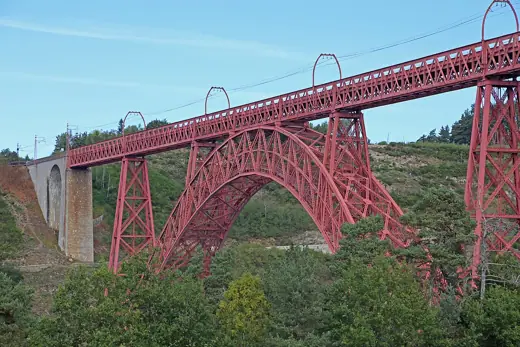
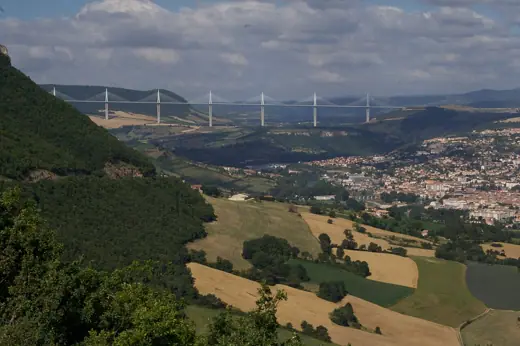
1/10 · Exterior · Garabit Viaduct (Viaduc de Garabit), a steel railway bridge built by Gustave Eiffel in the years 1880-1884Photo: W. Bulach · CC BY-SA 4.0 · source2/10 · Exterior · Garabit Viaduct (Viaduc de Garabit), a steel railway bridge built by Gustave Eiffel in the years 1880-1884Photo: W. Bulach · CC BY-SA 4.0 · source3/10 · ExteriorCC BY-SA 3.0 · source4/10 · Exterior · Le viaduc de Garabit vu depuis Anglards-de-Saint-FlourPhoto: Pymouss · CC BY-SA 4.0 · source5/10 · Detail · Garabit Viadukt - Detail of southern pierPhoto: Johannes Reimer · CC BY 4.0 · source6/10 · ContextPhoto: W. Bulach · CC BY-SA 4.0 · source7/10 · ElevationPhoto: Gustave Eiffel · Public domain · source8/10 · ElevationPhoto: Gustave Eiffel · Public domain · sourcePhotos unavailable9/10Gustave Eiffel · Public domain · sourcePhotos unavailable10/10Gustave Eiffel · Public domain · source
Key featuresWrought-iron parabolic arch, 165 m main span, 124 m above the Truyère river.
About the building
The Garabit Viaduct takes a single railway line across the gorge of the Truyère near Ruynes-en-Margeride, in the mountains of the Massif Central. Gustave Eiffel was handed the job without the usual competitive tender, his company having already bridged the Douro at Porto with the Maria Pia Bridge (1875–1877); Maurice Koechlin did the structural engineering. Work ran from 1882 to 1884, and it opened in November 1885. A parabolic arch spanning 165 m carries the line 124 m above the river; when finished it was the longest arch anywhere in the world. The whole crossing runs 565 m and weighs 3,587 tonnes. Passing trains make it deflect by about 8 mm, the same figure Eiffel had calculated.
Portrait: François Touranchet · Public domain · source
About Garabit Viaduct
The Garabit viaduct (French: viaduc de Garabit) is a railway arch bridge spanning the Truyère, near Ruynes-en-Margeride, Cantal, France, in the mountainous Massif Central region.
Rail traffic using the bridge causes a deflection (load displacement) of about 8 millimetres (0.315 in), which was the same value as the one calculated by Eiffel. The bridge, which is 124 m (407 ft) above the river, had the world's longest arch when it was completed in 1884. This was surpassed two years later with the opening of the Dom Luís I Bridge across the Douro in Porto, Portugal in 1886.
Until 11 September 2009, one regular daily Corail passenger train passed each way from Clermont-Ferrand to Béziers. However, the viaduct was closed when cracks were discovered in one of the foundation piles. The Garabit viaduct reopened the following month after a safety inspection, with a speed limit of 10 km/h (6.2 mph) for all traffic.
The bridge was constructed between 1882 and 1884 by Gustave Eiffel, with structural engineering by Maurice Koechlin, and was opened in 1885. It is 565 m (1,854 ft) in length and has a principal arch of 165 m (541 ft) span.