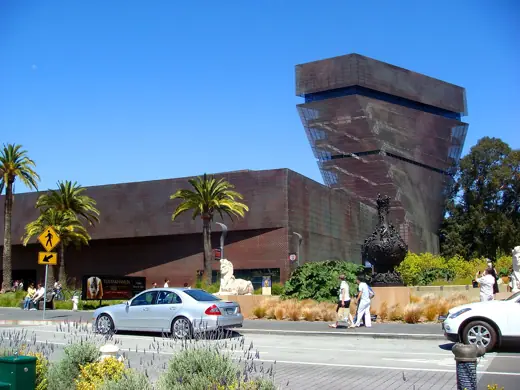
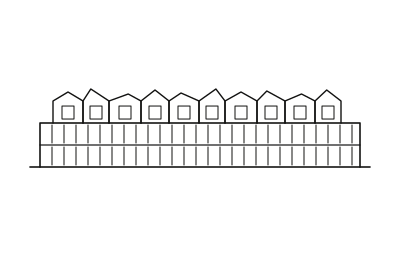
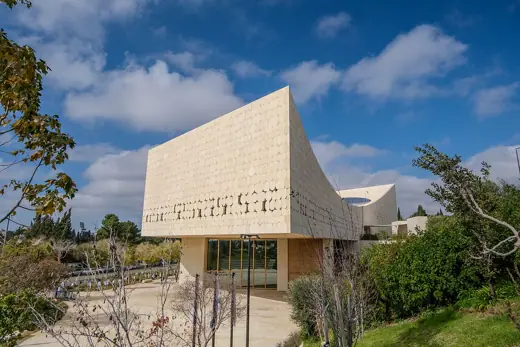
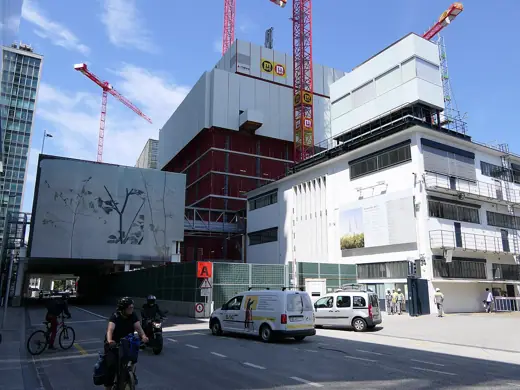
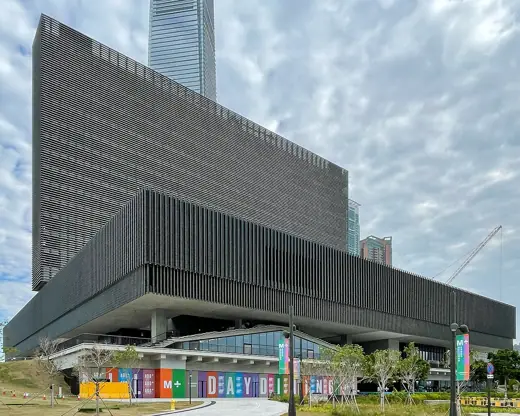
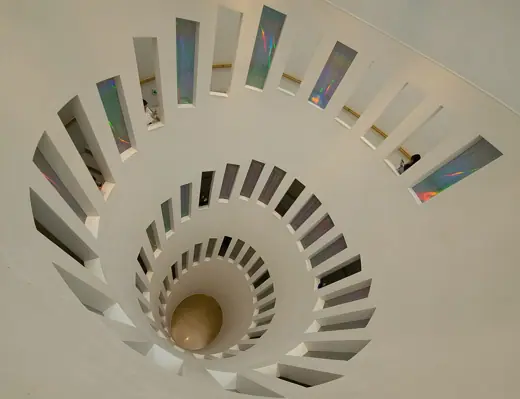
1/5 · Exterior · De Young Museum, San Francisco, in 2009 during the Tutankhamun exhibitionPhoto: Mark Miller · Public domain · source2/5 · Exterior · De Young Memorial MuseumPhoto: Tuxyso · CC BY-SA 3.0 · source3/5 · Exterior · A photo by Billie WardPhoto: Billie Grace Ward from New York, USA · CC BY 2.0 · source4/5 · Interior · Stairway at the de YoungPhoto: Sharon Mollerus · CC BY 2.0 · source5/5 · Detail · A section of the roof of the De Young Museum in San Francisco as seen from the Hamon Tower observation floorPhoto: BrokenSphere · CC BY-SA 3.0 · source
Key featuresA perforated, dimpled copper skin wraps low galleries and a twisting tower in Golden Gate Park.
About the building
The de Young Museum is a fine arts museum in Golden Gate Park in San Francisco. Its old building was badly damaged in the 1989 Loma Prieta earthquake and replaced; Herzog & de Meuron won the competition in January 1999 against Tadao Ando and Antoine Predock, and completed the new building with Fong + Chan; it opened on October 15, 2005. The ground and the risk of earthquakes in San Francisco were a challenge for the design. The whole exterior is clad in 163,118 sq ft of copper plates, perforated and dimpled in varying patterns, which is expected to oxidize and turn greenish over time to echo the nearby eucalyptus. A 144-foot tower attached to the museum is the highest point in the park. For students, it shows a skin designed to change with the weather.
The de Young Museum, formally the M. H. de Young Memorial Museum, is a fine arts museum located in San Francisco, California, United States, named for early San Francisco newspaperman M. H. de Young. Located on the West Side of the city in Golden Gate Park, it is a component of the Fine Arts Museums of San Francisco, along with the Legion of Honor.
The current building was completed by architects Jacques Herzog, Pierre de Meuron and Fong + Chan and opened on October 15, 2005. Structural, civil and geotechnical engineering was provided by Rutherford + Chekene; Arup Group provided mechanical and electrical engineering. Herzog & de Meuron won the competition in January 1999 beating out other short-listed architects Tadao Ando and Antoine Predock. The terrain and seismic activity in San Francisco posed a challenge for the designers Herzog & de Meuron and principal architects Fong & Chan. To help withstand future earthquakes, "[the building] can move up to three feet (91 centimeters) due to a system of ball-bearing sliding plates and viscous fluid dampers that absorb kinetic energy and convert it to heat".