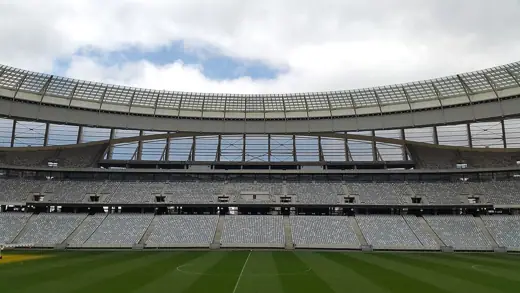
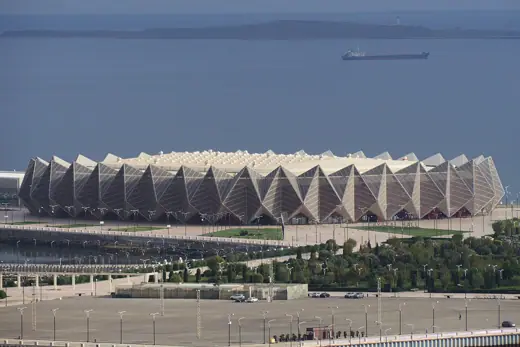
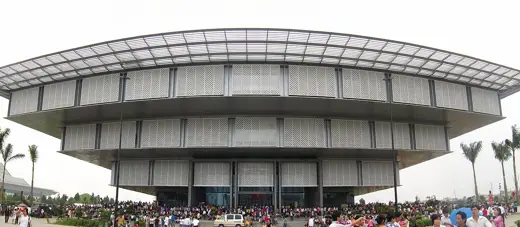
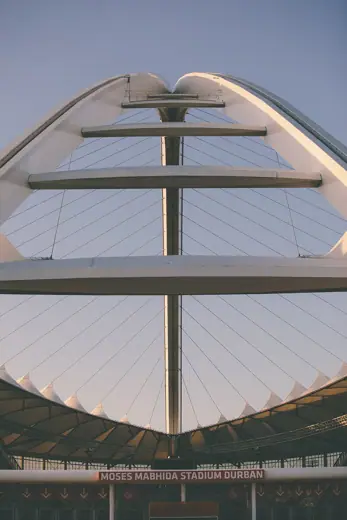
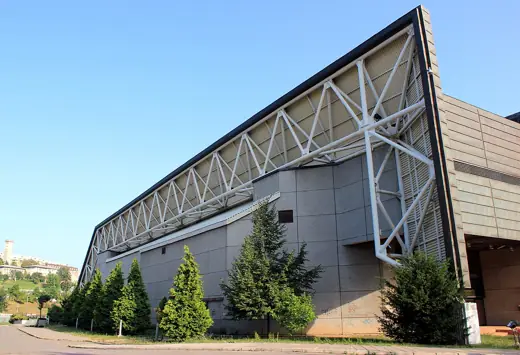
1/5 · Exterior · Cape Town Stadium, Cape Town, South AfricaPhoto: Deklerk Basson dkbasson · CC0 · source2/5 · Exterior · View of the V&A Waterfront and Cape Town Stadium from Signal HillPhoto: Josep M. Gracia · CC BY-SA 4.0 · source3/5 · ExteriorPhoto: South African Tourism from South Africa · CC BY 2.0 · source4/5 · Interior · From within the Cape Town Stadium, as seen in the background, the Table MountainPhoto: Nkansahrexford · CC BY-SA 4.0 · source5/5 · Interior · From within the Cape Town Stadium and as seen in the background, the Table MountainPhoto: Nkansahrexford · CC BY-SA 4.0 · source
Key featuresBuilt 2007-2009 on Green Point Common for the 2010 World Cup; designed by gmp with local firms.
About the building
Cape Town Stadium was built when South Africa hosted the 2010 FIFA World Cup and hosts football and rugby union; since 2021 a sponsor has named it the DHL Stadium. It sits on the Green Point Common, between Signal Hill and the Atlantic, near the city centre and the Victoria & Alfred Waterfront. Work began in March 2007 and took 33 months, with the contractors Murray & Roberts (now Concor) and WBHO, at a cost of R4.4 billion, about US$600 million. GMP Architects of Germany designed it with two local practices, Louis Karol Architects and Point Architects. It seated 64,100 for the World Cup. Afterwards, temporary rows on both sides of the top tier gave way to event suites and clubrooms, cutting capacity to 55,000. Greenpoint Park was completed within a year of the tournament, as promised in public consultation.
The Cape Town Stadium (Afrikaans: Kaapstad-stadion; Xhosa: Inkundla yezemidlalo yaseKapa; known since 2021 as the DHL Stadium for sponsorship reasons) is a football (soccer) and rugby union stadium in Cape Town, South Africa, that was built as part of the country's hosting of the 2010 FIFA World Cup.
Construction of the Cape Town Stadium, located on the Green Point Common, began in March 2007.
In 33 months, joint venture contractors Murray & Roberts, now known as Concor and WBHO completed the project at a cost of R4.4billion – or approximately US$600million.
The project architects were an association between GMP Architects of Germany and local firms, Louis Karol Architects and the joint venture practice Point Architects comprising Comrie Wilkinson Architects and Urban Designers, Jakupa Architects and Urban Designers, Munnik Visser Architects and Paragon Architects. The lead urban designer for the 18hactare stadium precinct was Henri Comrie.
The structural engineers comprised a joint venture between BKS, Henry Fagan & Partners, KFD Wilkinson, Goba, Iliso and Arcus Gibb.