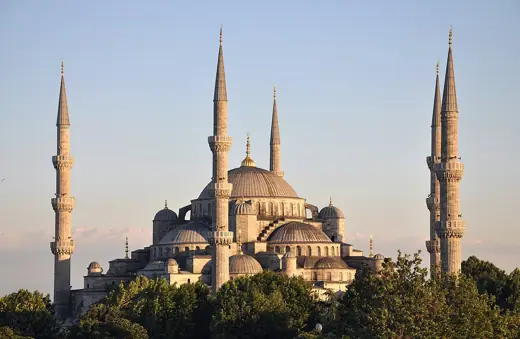
1/4 · Exterior · View of Blue Mosque in Istanbul , TurkeyPhoto: Moonik · CC BY-SA 3.0 · source2/4 · Exterior · View of Blue Mosque in Istanbul , TurkeyPhoto: Moonik · CC BY-SA 3.0 · source3/4 · Interior · Blue MosquePhoto: Nan Palmero from San Antonio, TX, USA · CC BY 2.0 · source4/4 · Interior · Blue Mosque IPhoto: Robert Anders from Hamburg, Germany · CC BY 2.0 · source
The Sultan Ahmed Mosque (Turkish: Sultanahmet Camii), popularly known as the Blue Mosque, is an Ottoman-era historical imperial mosque located in Istanbul, Turkey. It was constructed between 1609 and 1617 during the rule of Ahmed I. It attracts a large number of tourists and is one of the most iconic and popular monuments of Ottoman architecture.
The mosque has a classical Ottoman layout with a central dome surrounded by four semi-domes over the prayer hall. It is fronted by a large courtyard and flanked by six minarets. On the inside, it is decorated with thousands of Iznik tiles and painted floral motifs in predominantly blue colours, which give the mosque its popular name. The mosque's külliye (religious complex) includes Ahmed's tomb, a madrasa, and several other buildings in various states of preservation.
The mosque was built next to the former Hippodrome and stands across from the Hagia Sophia, another popular tourist site. The Blue Mosque was included in the UNESCO World Heritage Site list in 1985 under the name of "Historic Areas of Istanbul".