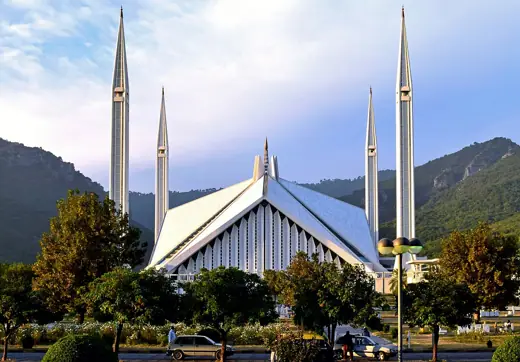
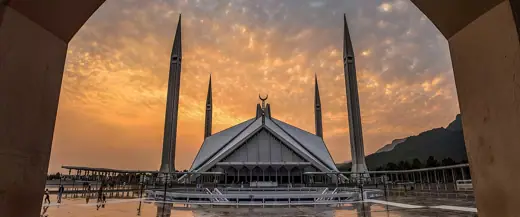
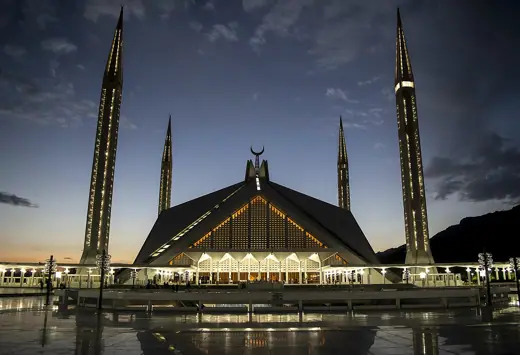
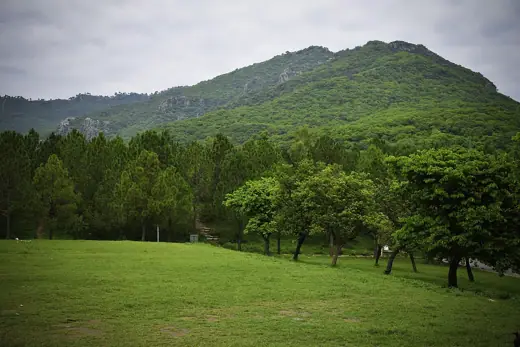
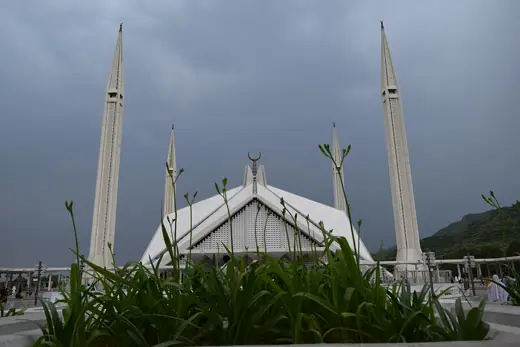
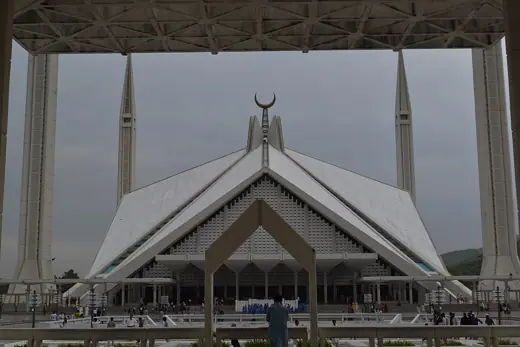
1/6 · Exterior · This is a photo of a monument in Pakistan identified as thePhoto: Ali Mujtaba · CC BY-SA 4.0 · source2/6 · Exterior · This is a photo of a monument in Pakistan identified as thePhoto: Ali Mujtaba · CC BY-SA 4.0 · source3/6 · Exterior · This is a photo of a monument in Pakistan identified as thePhoto: Ali Mujtaba · CC BY-SA 4.0 · source4/6 · Exterior · Margalla Hills behind the Faisal MosquePhoto: Younaspsh · CC BY-SA 3.0 · source5/6 · Interior · This is a photo of a monument in Pakistan identified as thePhoto: mhtoori photography · CC BY-SA 3.0 · source6/6 · Interior · This is a photo of a monument in Pakistan identified as thePhoto: Saanvel · CC BY-SA 3.0 · source
Religious · Late modernism
Faisal Mosque
Vedat Dalokay · Islamabad, PK · 1986
Key featuresFolded concrete tent-like shell over the prayer hall, with no dome, and four pencil minarets.
The Faisal Mosque is the national mosque of Pakistan, located in Islamabad, the capital of the country. It is the sixth-largest mosque in the world and located on the foothills of Margalla Hills. It is named after the late King Faisal of Saudi Arabia (r. 1964–75). Designed by Turkish architect Vedat Dalokay, the mosque features a contemporary design consisting of eight sides of concrete shell and is inspired by the design of a typical Bedouin tent.
I tried to capture the spirit, proportion, and geometry of Kaaba in a purely abstract manner. Imagine the apex of each of the four minarets as a scaled explosion of four highest corners of Kaaba – thus an unseen Kaaba form is bounded by the minarets at the four corners in a proportion of height to base. Shah Faisal Mosque is akin to the Holy Kaaba in the designer's imaginative eyes.
Now, if you join the apex of each minaret to the base of the minaret diagonally opposite to it correspondingly, a four-sided pyramid shall be bound by these lines at the base side within that invisible cube. That lower level pyramid is treated as a solid body while four minarets with their apex complete the imaginary cube of Kaaba.