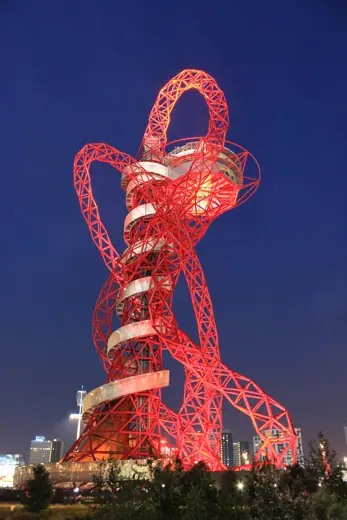
The ArcelorMittal Orbit (often referred to as the Orbit Tower or its original name, Orbit) is a 114.5-metre (376-foot) sculpture and observation tower in Queen Elizabeth Olympic Park in Stratford, London. It is Britain's largest piece of public art, and is intended to be a permanent lasting legacy of London's hosting of the 2012 Summer Olympic and Paralympic Games, assisting in the post-Olympics regeneration of the Stratford area. Sited between London Stadium (formerly called the Olympic Stadium) and the Aquatics Centre, it allows visitors to view the whole Olympic Park from two observation platforms.
Orbit was designed by Turner Prize–winning artist Anish Kapoor and Cecil Balmond of Arup Group, an engineering firm. Announced on 31 March 2010, it was expected to be completed by December 2011. The project came about after Mayor of London Boris Johnson and Olympics Minister Tessa Jowell decided in 2008 that the Olympic Park needed "something extra". Designers were asked for ideas for an "Olympic tower" at least 100 metres (330 ft) high: Orbit was the unanimous choice from proposals considered by a nine-person advisory panel.