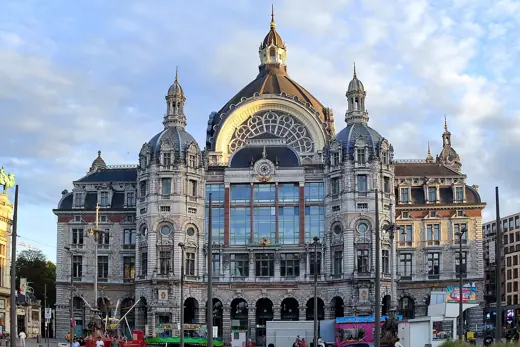
1/6 · ExteriorPhoto: Helmlechner · CC0 · source2/6 · ExteriorPhoto: Wikihydro · CC BY-SA 4.0 · source3/6 · Interior · Antwerp, central railway-station near the PelikaanstraatPhoto: Michielverbeek · CC BY-SA 4.0 · source4/6 · Interior · Antwerp, central railway-station near Comics StationPhoto: Michielverbeek · CC BY-SA 4.0 · source5/6 · InteriorPhoto: Renée Kools · CC BY 4.0 · source6/6 · SectionPhoto: Unknown to me, but the sketch must have been made by either Clément Van Bogaert (1865 – 1937) or by · Public domain · source
Key featuresStone-clad terminal building of 1895-1905; the viaduct into the station is by Jan Van Asperen.
About the building
Antwerp's main railway station is one of Belgium's key hubs and one of four in the country on the high-speed network. Louis Delacenserie's stone-clad terminal building went up between 1895 and 1905, replacing the first station. A vast dome over the waiting hall earned it the nickname spoorwegkathedraal, "railroad cathedral". The engineer Clément Van Bogaert designed the train hall, first built of iron and glass: 185 m long, 43 to 44 m high and covering 12,000 m²; the station's height was needed to clear steam locomotive smoke. A tunnel between Antwerpen-Berchem to the south and Antwerpen-Dam to the north passes beneath it, with platforms on two underground levels. It is widely seen as Belgium's finest railway building, though its many influences make its style hard to name. In 2011 it won a Grand Prix at the Europa Nostra Awards.
Antwerpen-Centraal railway station (Dutch: Station Antwerpen-Centraal; French: Gare d'Anvers-Central) is the main railway station in Antwerp, Belgium. It is one of the most important hubs in the country and is one of the four Belgian stations on the high-speed rail network. From 1873 to early 2007, it was a terminal station. The current building, designed by the architect Louis Delacenserie, was constructed between 1895 and 1905. On 23 March 2007, a tunnel with two continuous tracks was opened under part of the city and under the station. The train services are operated by the National Railway Company of Belgium (NMBS/SNCB).
The station is widely regarded as the finest example of railway architecture in Belgium, although the extraordinary eclecticism of the influences on Delacenserie's design had led to a difficulty in assigning it to a particular architectural style. In W. G. Sebald's novel Austerlitz an ability to appreciate the full range of the styles that might have influenced Delacenserie is used to illustrate the brilliance of the fictional architectural historian who is the novel's protagonist. Owing to the vast dome above the waiting room hall, the building became colloquially known as the spoorwegkathedraal ("railroad cathedral").