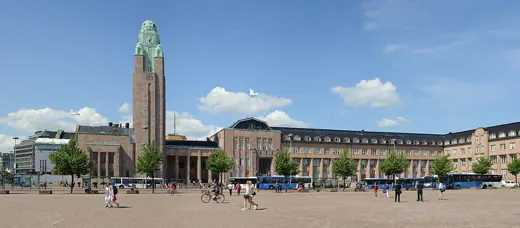
1/8 · Exterior · The Central Railway Station in Helsinki, Rautatientori SquarePhoto: Alvesgaspar · CC BY-SA 3.0 · source2/8 · Exterior · Central Railway Station in Helsinki, FinlandPhoto: Richardmaackphotography · CC BY 4.0 · source3/8 · Exterior · Helsinki Railway Station, western entrancePhoto: Manster323 · CC0 · source4/8 · Exterior · Rautatieaseman jalankulkutunneliPhoto: Coen · CC BY-SA 4.0 · source5/8 · Exterior · Itäinen Heikinkatu 13, 15 (Mannerheimintie 9), näkymä Hankkijan liiketalon katoltaPhoto: unknown · CC BY-SA 4.0 · source6/8 · Interior · The Central railway station being rather quiet during the COVID-19 pandemicPhoto: Eliel Saarinen · CC BY 4.0 · source7/8 · Interior · Interior of Helsinki Central Railway Station at nightPhoto: Leonhard Lenz · CC0 · source8/8 · Plan · Helsingin rautatieaseman alkuperäinen pohjapiirustusPhoto: Bruno Granholm · Public domain · source
Key featuresGranite station with a clock tower and lamp-bearing figures framing a vaulted main hall.
About the building
Eliel Saarinen designed Helsinki Central Station, which opened in 1919. His winning competition scheme, titled "A winged wheel standing on a globe", was purely national romantic: heavy walls, eight bears, one tall pointed tower and many smaller ones, and a finely drawn stone gateway to the main platform. It provoked calls for a modern, rational style in major public buildings. Back in Finland in 1904, Saarinen dropped romanticism and redrew the station on rational lines. Large concrete vaults roof the halls and show clearly in the outer form; built with the Hennebique system patented in France in 1892, they were then the largest reinforced concrete structure the state had commissioned. The granite-clad station is known for its clock tower and Emil Wikström's Lantern Bearers statues; the main front and the stone figures at the entrance are red Hanko granite.
Helsinki Central Station (Finnish: Helsingin päärautatieasema, Swedish: Helsingfors centralstation) (HEC) is the main station for commuter rail and long-distance trains departing from Helsinki, Finland. About 200,000 people "pass through the station" every day, half of whom are train passengers. The station serves as the terminus for all trains in the Helsinki commuter rail network, as well as for all Helsinki-bound long-distance trains in Finland. The Rautatientori (Central Railway Station) metro station is located in the same building.
Helsinki Central Station is one of Eliel Saarinen’s best-known works in Finland. It is architecturally and technically innovative and is one of the most prominent landmarks in the Helsinki city centre. It is also considered an important example of Finnish architecture.
Following its completion in 1914, the station attracted international attention and has subsequently been regarded as an important example of railway station architecture. The German architecture press described it as the most beautiful railway station in the world. The station building also served as an inspiration for the design of the Singapore railway station.