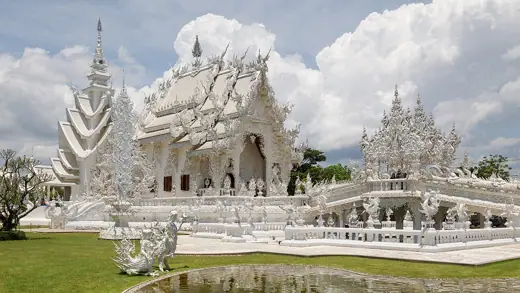
1/5 · Exterior · Chiang Rai, Thailand: Wat Rong Khun, also known as "The White Temple"Photo: CEphoto, Uwe Aranas · CC BY-SA 4.0 · source2/5 · Exterior · Chiang Rai, Thailand: Wat Rong Khun, also known as "The White Temple"Photo: CEphoto, Uwe Aranas · CC BY-SA 4.0 · source3/5 · Exterior · Wat Rong Khun (White Temple), Chiang RaiPhoto: Chainwit · CC BY 4.0 · source4/5 · Exterior · White Temple Wat Rong Khun, Chiang RaiPhoto: Hans-Jürgen Neubert · CC BY 4.0 · source5/5 · Context · 01 General View from South, White Temple, Chiang RaiPhoto: Photo Dharma from Sadao, Thailand · CC BY 2.0 · source
Key featuresAll-white ubosot set with mirrored glass fragments that sparkle; bridge lined with outstretched hands.
About the building
Wat Rong Khun, widely called the White Temple, is a private contemporary art work in the form of a Buddhist temple, in Chiang Rai province, Thailand. Chalermchai Kositpipat, a national artist from the area, chose to rebuild the temple entirely with his own money; he designed and built it, welcoming visitors from 1997. Work continues and is not expected to end until 2070. Structurally it is a plain concrete frame with a wooden roof. From afar it seems made of glittering porcelain; up close the shine proves to be whitewash with clear mirror chips. The main hall, or ubosot, is approached across a bridge over a small lake, past hundreds of reaching hands that represent unchecked desire. All white and studded with mirror glass, it borrows from classic Thai architecture in its three-tiered roof and its many Nāga serpents.
Wat Rong Khun (Thai: วัดร่องขุ่น), better known as the White Temple, is a contemporary, privately owned art exhibit in the style of a Buddhist temple in Pa O Don Chai, Mueang District, Chiang Rai province, Thailand. Situated outside the city of Chiang Rai, the site attracts a large number of visitors, both Thai and foreign, making it one of Chiang Rai's most visited attractions. The White Temple was created by master Chalermchai Kositpipat, the national artist who designed, constructed, and opened it to visitors in 1997.
The primary structure of the temple is made of a basic concrete frame and a wooden roof. Viewed from a distance, it appears to be crafted from sparkling porcelain, but on closer inspection it becomes evident that the dazzling effect is achieved through a blend of whitewash and transparent mirrored chips. The outer surfaces are adorned with white plaster and incorporated glass inserts.