Key featuresStadium built around a 1994 stand, now under a single tensile roof ring wrapping all four sides.
About the building
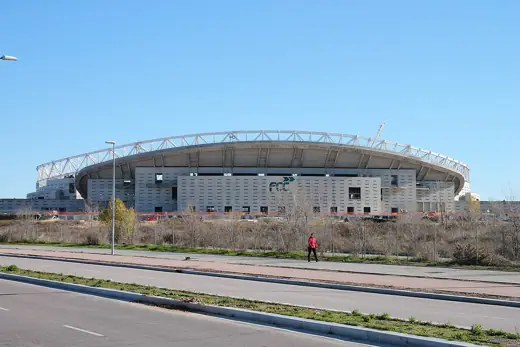
Atlético Madrid's home ground since 2017, the Metropolitano Stadium stands in the Rosas neighbourhood of Madrid's San Blas-Canillejas district and now officially carries the sponsor's name Riyadh Air Metropolitano. Its story starts earlier: work on a stadium here began in 1990 to a design by Cruz y Ortiz, a single tier of 20,000 seats nicknamed La Peineta because its outline recalled a traditional hair comb. That venue was later rebuilt, and the new ground, credited to Cruz y Ortiz, opened on 16 September 2017 with a La Liga match against Málaga, reopening with 68,456 seats. The club borrowed the Metropolitano name from the arena where it played between 1923 and 1966. The rebuilt ground was the world's first 100% LED stadium, and on 1 June 2019 it staged the UEFA Champions League Final, in which Liverpool beat Tottenham Hotspur 2–0.
The Metropolitano Stadium (Spanish: Estadio Metropolitano), officially referred to as Riyadh Air Metropolitano Stadium due to sponsorship, is a football stadium in Madrid, located in the Rosas neighbourhood in the San Blas-Canillejas district. It has been the home stadium of Atlético Madrid since 2017.
The original stadium was built as part of Madrid's unsuccessful bid to host the 1997 World Athletics Championships, and was opened on 6 September 1994 by the Community of Madrid. It was closed in 2004 due to the city's unsuccessful bid for the 2016 Olympics and in 2013 it passed into the possession of Atlético Madrid. The stadium was rebuilt and the new facility was reopened to the public on 16 September 2017, when Atlético Madrid faced Málaga in La Liga. The stadium had a capacity of 20,000 spectators upon its closure and re-opened with a seating capacity of 68,456 after it was rebuilt. By September 2023, this had been extended to a capacity of 70,460. The capacity then increased to 70,692 with the creation of two skyboxes, expanded VIP seatings, and an additional platform for persons with disabilities. In 2026, the capacity increased again, having now 70,813 seats.