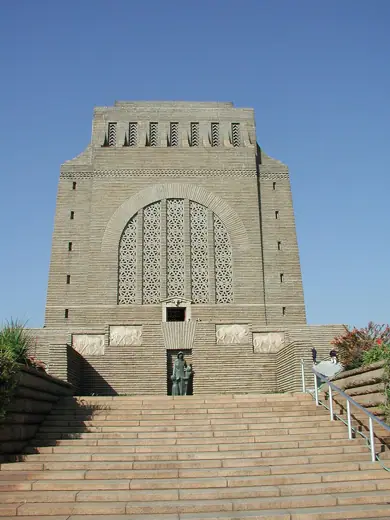


Memorial · Art Deco
Voortrekker Monument
Key featuresGranite block whose dome oculus sends a single sunbeam onto the cenotaph once a year.
About the building
The Voortrekker Monument, a granite structure on a Pretoria hilltop, honours the Voortrekkers, who left the Cape Colony in 1835–1854. Gerard Moerdijk designed it, and Prime Minister D. F. Malan inaugurated it on 16 December 1949. Standing 62 metres high on a 40 by 40 metre base, it recalls European monuments such as the Dôme des Invalides and the Völkerschlachtdenkmal yet shows African influences. A gate leads into a laager of 64 granite ox-wagons, as many as at the Battle of Blood River. A vast inner space flanked by four arched windows of yellow Belgian glass holds the Historical Frieze, the world's biggest in marble. A round opening in the Hall of Heroes floor looks down on the Cenotaph; at noon each 16 December, sunlight through an oculus in the dome falls on its words 'Ons vir Jou, Suid-Afrika'.
Sources: Voortrekker Monument (Wikipedia)
More with monumentalityAll 909 →
Find more with
Monumentality909 buildings →Light from above406 buildings →Stone524 buildings →Memorial119 buildings →Each opens every building that shares the idea.