




Office & tower · Postmodernism
Taipei 101
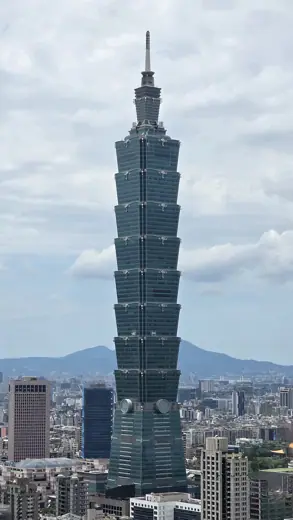
Key featuresEight stacked pagoda-like modules, with a 660-tonne tuned mass damper hung near the top.
About the building
Taipei 101 was officially the world's tallest building from its opening day, 31 December 2004, until the Burj Khalifa passed it in 2009. C. Y. Lee's postmodernist and neo-futurist design evokes traditional Asian aesthetics through a modern structure of industrial materials. The main tower is made of eight stacked sections, each eight floors high; in Chinese-speaking cultures, eight is linked with prosperity, abundance and good fortune. These blocks recall a pagoda, a bamboo stalk and a stack of ancient Chinese ingots or money boxes. With a major fault line 200 metres away, outrigger trusses every eight floors tie the core columns to the outer ones. A 660-tonne steel pendulum by Motioneering, hung between the 92nd and 88th floors, offsets sway from strong gusts, and double chamfered corners sharply cut crosswind movement. It gained LEED Platinum certification in 2011.
Sources: Taipei 101 · Chu-yuan Lee (Wikipedia)
More by C. Y. LeeAll 2 →
More with structure as expressionAll 668 →
Find more with
Structure as expression668 buildings →Megastructure70 buildings →Geometry1061 buildings →Office & tower349 buildings →Each opens every building that shares the idea.
Details
- Architect
- C. Y. Lee
- Place
- Taipei, Taiwan
- Year
- 2004
- Typology
- Office & tower
- Movement
- Postmodernism
- Region
- East Asia

Go deeper



More · Office & towerAll 349 →
Portrait: 準建築人手札網站 · CC BY 2.0 · source