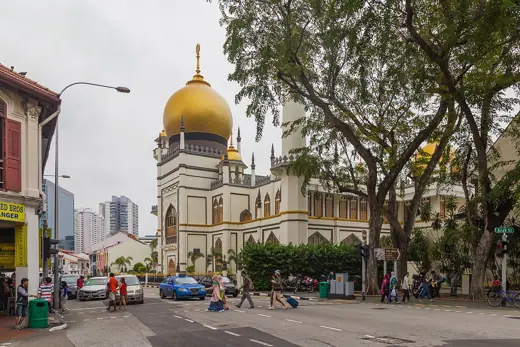
1/6 · Exterior · Sultan Mosque (Masjid Sultan)Photo: Marcin Konsek · CC BY-SA 4.0 · source2/6 · Exterior · Sultan Mosque, SingaporePhoto: Chainwit · CC BY-SA 4.0 · source3/6 · Exterior · Sultan Mosque, SingaporePhoto: Chainwit · CC BY-SA 4.0 · source4/6 · Exterior · Masjid SultanPhoto: Photograph by Mike Peel ( www.mikepeel.net ) · CC BY-SA 4.0 · source5/6 · Interior · Sultan Mosque (Masjid Sultan)Photo: Marcin Konsek · CC BY-SA 4.0 · source6/6 · Interior · Masjid Sultan, the Jewel of Kampong Glam, an Islamic architecture in the heart of SingaporePhoto: Nadyn · CC BY-SA 4.0 · source
Key featuresTwo gold onion domes decorated with glass bottle ends, and two eight-storey minarets on the east facade.
About the building
Sultan Mosque in Singapore was first built in 1826 and rebuilt in its present form in 1932 to designs by Irish architect Denis Santry of Swan & Maclaren. Between 1925 and 1931 parts of the old mosque were pulled down and rebuilt in stages, partly for lack of funds and partly so daily prayers could go on. Its classical style draws on Indo-Saracenic architecture. The prayer hall and memorial face Mecca, askew to Muscat Street and North Bridge Road. Two matching gold onion domes with crescent-and-star finials top the corners; their bases are set with the cut ends of glass bottles collected from the poor during the rebuilding. Two eight-storey minarets flank the eastern facade, the only ones in the country still allowed to broadcast the call to prayer. It was made a national monument in 1975.
The Sultan Mosque (Jawi: مسجد سلطان) is a historic congregational mosque located in the Kampong Glam district of Rochor, Singapore. First built in 1826 and later rebuilt into its current form in 1932, the Sultan Mosque is one of the national monuments of Singapore and is considered to be the most well-known mosque in the country.
The Sultan Mosque is built with a classical architectural style influenced by Indo-Saracenic architecture. The main building of the mosque, which includes its main prayer hall and memorial, face the direction of Mecca and are not aligned with Muscat Street and North Bridge Road. The compound of the mosque is enclosed by railings and concrete walls, with rear and front entrances.
The mosque has two identical gold-coloured onion domes that top each corner of the main building. Each onion dome is topped by a crescent-and-star emblem, while the base of the domes are both adorned with the sawn-off ends of glass bottles that were collected from the poor during the reconstruction process of the mosque. The dome facing North Bridge Road tops a private memorial that contains a cenotaph dedicated to Tengku Alam Shah and his family, who were formerly buried in a mausoleum behind the mosque.