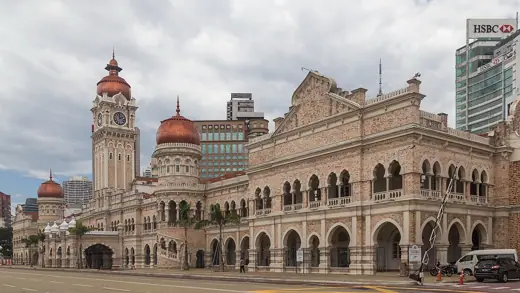
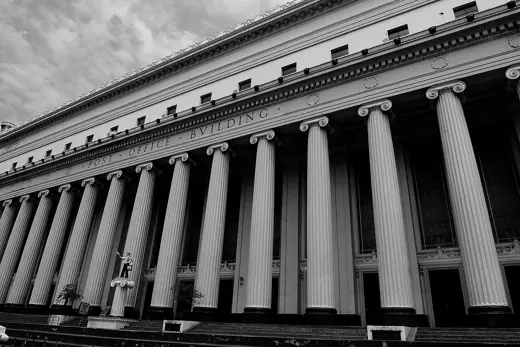
1/7 · Exterior · Sultan Abdul Samad BuildingPhoto: Marcin Konsek · CC BY-SA 4.0 · source2/7 · Exterior · Sultan Abdul Samad BuildingPhoto: Marcin Konsek · CC BY-SA 4.0 · source3/7 · Exterior · Sultan Abdul Samad Building, Kuala Lumpur, MalaysiaPhoto: Diego Delso · CC BY 3.0 · source4/7 · Exterior · The Sultan Abdul Samad Building and the Gombak River in Kuala LumpurPhoto: Own work · CC0 · source5/7 · Interior · Kuala Lumpur, Malaysia: A stair tower of the Sultan Abdul Samad BuildingPhoto: CEphoto, Uwe Aranas · CC BY-SA 3.0 · source6/7 · Interior · Townhall shaped building at Kuala LampurPhoto: Gausanchennai · CC BY-SA 4.0 · source7/7 · Model · Miniature faking or tilt shift faking by post processingPhoto: Tilt Shift Perspective · CC BY-SA 4.0 · source
Key features41 m clock tower in the Indo-Saracenic manner, with copper-clad onion domes on three towers.
About the building
First known simply as the Government Offices, this Kuala Lumpur building held the British colonial government's offices. A. C. Norman drew the first scheme, with R. A. J. Bidwell assisting, in a Classical Renaissance manner, but Spooner disliked it, so Bidwell reworked it under his guidance into a style called Indo-Saracenic, Neo-Mughal or Moorish. Only Norman's name is on the foundation stone and his ground plan stayed, yet the design is largely Bidwell's, and A. B. Hubback added to it and designed its fixtures. The two-storey plan is roughly an F, its long top stroke forming the front. A 41-metre clock tower at the centre was meant to recall Big Ben in Indo-Saracenic dress, and each of the three towers carries a copper-clad onion dome. Red brick with white plaster bands and arches gives the look called "blood and bandages".
The Sultan Abdul Samad Building (Malay: Bangunan Sultan Abdul Samad; Jawi: باڠونن سلطان عبدالصمد) is a late-19th-century building located along Jalan Raja in front of Dataran Merdeka and the Royal Selangor Club in Kuala Lumpur, Malaysia. The building originally housed the offices of the British colonial administration, and was known simply as Government Offices in its early years. In 1974, it was renamed after Sultan Abdul Samad, the reigning sultan of Selangor at the time when construction began.
The building once housed the superior courts of the country: the Federal Court of Malaysia, the Court of Appeals and the High Court of Malaya; the Federal Court and the Court of Appeals relocated to the Palace of Justice in Putrajaya in 2003, while the High Court of Malaya shifted to the Kuala Lumpur Courts Complex in Segambut in 2007. Later, it housed the offices of the Ministry of Communications and Multimedia and the Ministry of Tourism and Culture of Malaysia.
The building was most recently restored in 2026, and contains galleries, exhibition spaces and several cafés.