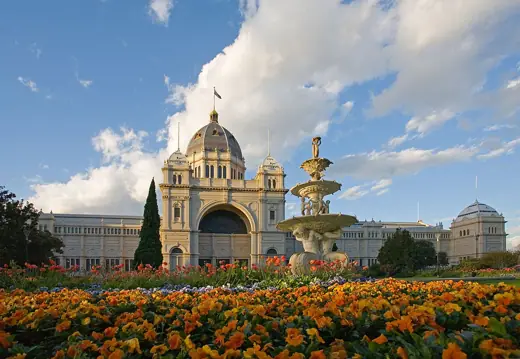
1/6 · Exterior · A view of the south-facing side of the Royal Exhibition Building in Melbourne, AustraliaPhoto: Photograph taken by Diliff and straightened by Ian Fieggen · CC BY 2.5 · source2/6 · Exterior · A northwest view of Royal Exhibition Building, MelbournePhoto: DXR · CC BY-SA 4.0 · source3/6 · Exterior · A west view of Royal Exhibition Building, MelbournePhoto: DXR · CC BY-SA 4.0 · source4/6 · Exterior · Dome of the Royal Exhibition Building, Melbourne, AustraliaPhoto: Bernard Gagnon · CC BY-SA 4.0 · source5/6 · InteriorPhoto: Joseph Reed (1832 - 1890) – Artist (English) Born in Cornwall, England. Died in Melbourne, Victoria · Public domain · source6/6 · InteriorPhoto: Joseph Reed (1832 - 1890) – Artist (English) Born in Cornwall, England. Died in Melbourne, Victoria · Public domain · source
Key featuresGreat exhibition hall on a cross-shaped plan of nave and transepts meeting under a dome.
About the building
Melbourne's Royal Exhibition Building, built in 1879–1880, belongs to the international exhibition movement, which ran over 50 exhibitions worldwide from 1851 to 1915. Local architect Joseph Reed beat seventeen other entries to the £300 first prize. Its materials are brick, timber, steel and slate, and its styles Romanesque, Byzantine, Lombardic and Italian Renaissance; the dome follows Florence Cathedral. The plan, on a French Beaux-Arts scale, is a Latin cross: two long nave-like wings run east and west of the central dome, with a shorter one to the north, and windows in the drum light the crossing. Its foundation stone was laid on 19 February 1879, and it opened 18 months later, on 1 October 1880. Australia's first Parliament was opened there on 9 May 1901. In 2004 it was the first Australian building to gain UNESCO World Heritage status.
Portrait: John William Lindt (1845-1926) · Public domain · source
About Royal Exhibition Building
The Royal Exhibition Building is a UNESCO World Heritage-listed building in Melbourne, Victoria, Australia, built in 1879–1880 as part of the international exhibition movement, which presented over 50 exhibitions between 1851 and 1915 around the globe. The building sits on approximately 26 hectares (64 acres), is 150 metres (490 ft) long and is surrounded by four city streets. It is situated at 9 Nicholson Street in the Carlton Gardens, flanked by Victoria, Carlton and Rathdowne Streets, at the north-eastern edge of the central business district. It was built to host the Melbourne International Exhibition in 1880–81, and then hosted the even larger Centennial International Exhibition in 1888. It was then chosen as the site for the Federation of the Commonwealth of Australia in 1901. The building is representative of the financial wealth and pride that the city of Melbourne and state of Victoria had in the 1870s. Throughout the 20th century smaller sections and wings of the building were subject to demolition and fire; however, the main building, known as the Great Hall, survived.