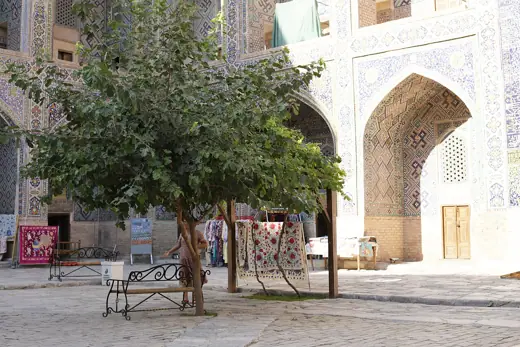
1/6 · Exterior · A tree and performers occupy a richly decorated Registan courtyardPhoto: AIDEPCUL · CC BY 4.0 · source2/6 · Exterior · A local woman sits beside a richly tiled wall in the Registan ensemblePhoto: AIDEPCUL · CC BY 4.0 · source3/6 · Interior · People rest on a traditional raised platform inside a richly tiled historic courtyard at RegistanPhoto: AIDEPCUL · CC BY 4.0 · source4/6 · Interior · Vue de Samarcande, en OuzbékistanPhoto: Jean Housen · CC BY-SA 4.0 · source5/6 · Detail · Elements of the Sherdor madrasa; RegistanPhoto: LBM1948 · CC BY-SA 4.0 · source6/6 · Model · Maquette of the Registan Square, which is located in the center of Samarkand cityPhoto: Mysportedit · CC BY-SA 4.0 · source
Registan, officially the Registan Square (Uzbek: Registon maydoni) is a historic public square in the city of Samarkand, Uzbekistan. It served as the heart of the Timurid Empire and later as the city's commercial, educational, and ceremonial center. The square is famed for its ensemble of three madrasas (Islamic schools): the Ulugh Beg Madrasa of the Timurid period, the Sherdar Madrasa and the Tilakari Madrasa, built later under the Janid dynasty—which together represent some of the finest achievements of Islamic architecture in Central Asia. Renowned for its soaring iwans, turquoise domes, intricate mosaic tilework, and geometric ornamentation, Registan is considered one of the greatest examples of Timurid and Persian-influenced architecture..
Several decades after the Mongol conquest, a Friday mosque was erected on Registan Square in Samarkand, the site that had served as the focal point of the Sarbadar uprising of 1365.
People gathered on the Registan to hear royal proclamations, heralded by blasts on enormous copper pipes called dzharchis — and for public executions. The three madrasas feature distinctive Islamic style with muqarnas. The square was regarded as the hub of the Timurid Renaissance.