




Infrastructure · Contemporary
Queen Alia International Airport

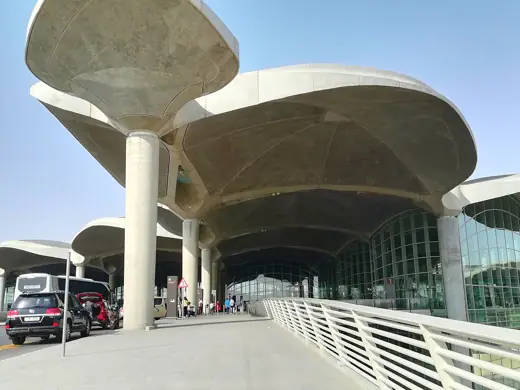
Key featuresA roof of 127 shallow concrete domes on columns, inspired by Bedouin tents, shades the terminal.
About the building
Queen Alia International Airport sits at Zizya, 30 kilometres south of Amman, Jordan's capital and biggest city. It first opened in 1983, built because traffic had outgrown Amman Civil Airport. Foster + Partners designed new terminals, and once these were inaugurated in 2013 the original ones were pulled down. Bedouin tents gave the idea for the new roof, a field of 127 concrete domes that weigh as much as 600 tonnes each. The old terminal saw its final departure at 10:05 pm on 20 March 2013. Every operation then moved across to the new building, whose own first flight took off at 2:30 am the next day, 21 March 2013.
Sources: Queen Alia International Airport (Wikipedia)
More by Norman FosterAll 43 →

More with vaultAll 130 →
DocumentariesAll documentaries →
Find more with
Vault130 buildings →Modular104 buildings →Climate response258 buildings →Infrastructure223 buildings →Each opens every building that shares the idea.
Details
- Place
- Amman, Jordan
- Year
- 2013
- Typology
- Infrastructure
- Movement
- Contemporary
- Region
- Middle East
Go deeper





More · InfrastructureAll 223 →
Portrait: Diario de Madrid · CC BY 4.0 · source