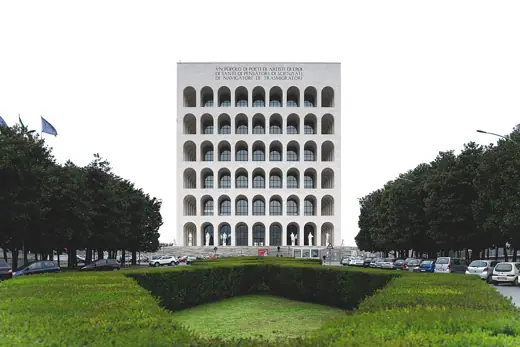
1/7 · Exterior · Palazzo della Civiltà Italiana in EUR in RomePhoto: Alberti1492 · CC BY-SA 4.0 · source2/7 · Exterior · Palazzo della Civiltà Italiana, viewed from the north on Autostrada A91, Rome, ItalyPhoto: Julian Lupyan · CC0 · source3/7 · Exterior · Vista del Palazzo della Civiltà Italiana, angolo sud-ovestPhoto: Patrickhlauke · CC BY-SA 4.0 · source4/7 · Exterior · Il Palazzo della Civiltà - Eur - RomaPhoto: ABerchet · CC BY-SA 4.0 · source5/7 · Detail · Roma EUR (Italy) - Palazzo della Civiltà Italiana - DetailPhoto: Gianni Cocconi · CC BY-SA 4.0 · source6/7 · DetailPhoto: dalbera from Paris, France · CC BY 2.0 · source7/7 · Model · Palazzo della Civiltà italiana, modello del 1940 circaPhoto: Alessandro Nassiri for Museo nazionale scienza e tecnologia, Milano · CC BY-SA 4.0 · source
The Palazzo della Civiltà Italiana ("Palace of Italian Civilization"), also known as the Palazzo della Civiltà del Lavoro ("Palace of Working Civilization"), or in everyday speech as the Colosseo Quadrato ("Square Colosseum"), is a building in the EUR district in Rome, Italy. It was designed in 1938 by three Italian architects: Giovanni Guerrini, Ernesto Lapadula, and Mario Romano. The building is an example of Italian Rationalism and fascist architecture with neoclassical design, representing romanità, a philosophy which encompasses the past, present, and future all in one. The monumentality of the structure was meant to reflect the fascist regime's new course in Italian history. The design of the building draws inspiration from the Colosseum with rows of arches. According to legend, the structure's six vertical and nine horizontal arches are correlated to the number of letters in the Italian dictator Benito Mussolini's name.
The EUR provides a large-scale image of how urban Italy might have looked if the Fascist regime had not fallen during the war – large, symmetrical streets and austere buildings of limestone, tuff and marble, in either Stile Littorio (lictor), inspired by ancient Roman architecture, or Rationalism. Its architectural style is often called simplified neoclassicism. Marcello Piacentini, the coordinator of the commission for E42, based it on the Italian Rationalism of Pagano, Libera, and Michelucci.