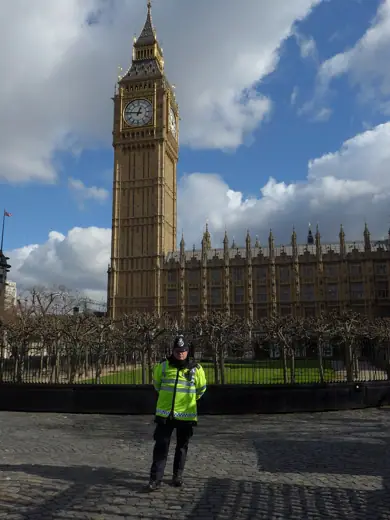
1/8 · ExteriorPhoto: Olivier_Teyssandier · CC BY-SA 4.0 · source2/8 · Exterior · Houses of Parliament, Palace of WestminsterPhoto: Tim Heaton · CC BY-SA 2.0 · source3/8 · Exterior · Big Ben Clock Tower in 2025Photo: MBShuler72 · CC BY-SA 4.0 · source4/8 · Exterior · Westminster Bridge with Palace of WestminsterPhoto: Photograph by Mike Peel ( www.mikepeel.net ) · CC BY-SA 4.0 · source5/8 · PlanPhoto: Denison, E. B · Public domain · source6/8 · Plan · Palace of Westminster, PlanPhoto: Alfred Barry · Public domain · source7/8 · PlanPhoto: It is probably an original drawing produced by Charles Barry's office · Public domain · source8/8 · PlanPhoto: Alfred Barry · Public domain · source
Key featuresPerpendicular Gothic Revival style with ornate decoration, designed by a classical architect.
About the building
The Palace of Westminster, where the UK Parliament meets, is largely the replacement built after a second, bigger fire wrecked most of the old palace in 1834. The eleventh-century Westminster Hall was spared and absorbed into the new building. Charles Barry won the design competition and picked Gothic Revival, a style he had little experience with, so he leaned heavily on Augustus Pugin for the details. Work began in 1840 and lasted 30 years, slowed by delays and cost overruns, and both Barry and Pugin, his assistant, died while it went on. Known for its ornate decoration, the palace helped Gothic Revival spread elsewhere. Its Elizabeth Tower, home of the bell nicknamed Big Ben, is a landmark of London and the UK. The palace became Grade I listed in 1970 and joined a UNESCO World Heritage Site in 1987.
The Palace of Westminster is the meeting place of the Parliament of the United Kingdom and is located in London, England. It is colloquially known as the Houses of Parliament after the House of Commons and the House of Lords, the two legislative chambers which occupy the building. The palace is one of the centres of political life in the United Kingdom; "Westminster" has become a metonym for the UK Parliament and government, and the Westminster system of government commemorates the name of the palace. The Elizabeth Tower of the palace houses the bell nicknamed Big Ben and is a landmark of London and the United Kingdom in general. The palace has been a Grade I listed building since 1970 and part of a UNESCO World Heritage Site since 1987.
The palace is a roughly rectangular building with its long axis parallel to the River Thames. The building is planned around the Central Lobby, a large hall from which corridors lead north to the Commons Chamber, south to the Lords Chamber, and west to the public entrance and Westminster Hall; to the east are committee rooms and libraries. A suite of rooms known as the Royal Apartments is at the disposal of the reigning monarch; they lie beyond the Lords' Chamber at the far south of the palace.