




Museum · Contemporary
Ningbo History Museum

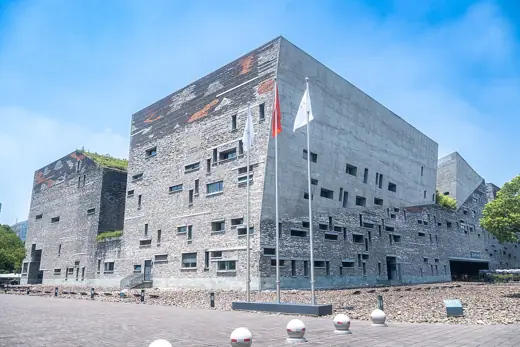
Key featuresWalls laid in 'wapan' from tiles and bricks salvaged from demolished villages.
About the building
Opened on 5 December 2008 in Yinzhou District, the Ningbo History Museum presents the history and traditional customs of the Ningbo area. Its architect, Wang Shu, became in 2012 the first Chinese citizen to receive the Pritzker Architecture Prize. The concept combines mountains, water and oceans. The first three levels form a single square base with the main entrances and offices, while the galleries above break apart, like the nearby mountains, into five smaller, sharply geometric sections. Stones and bricks salvaged from demolished buildings in the area were laid by builders, who were given some freedom, using the wapan technique; other walls carry cement-covered bamboo, with each wall's angle deciding its material. Reported to be the first museum to use large quantities of second-hand materials, it won the Lu Ban Prize, China's top architecture award, in 2009.
Sources: Ningbo History Museum (Wikipedia)
More by Wang ShuAll 3 →
More with reclaimed materialAll 26 →
Find more with
Reclaimed material26 buildings →Brick332 buildings →Sculptural form769 buildings →Museum735 buildings →Each opens every building that shares the idea.
Details
- Place
- Ningbo, China
- Year
- 2008
- Typology
- Museum
- Movement
- Contemporary
- Region
- East Asia
Go deeper





See all 8 links


More · MuseumAll 735 →

Portrait: Hsieh_Ying-Chun_and_Wang-Shu.jpg : Movez derivative work: ELEKHH T · CC BY 2.0 · source