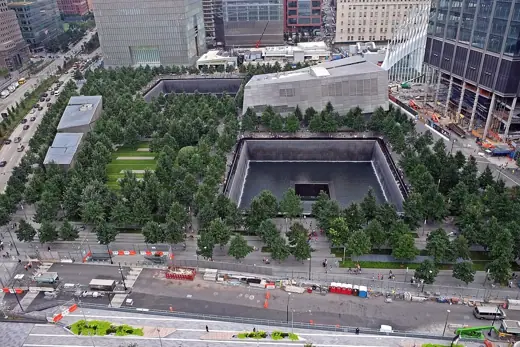
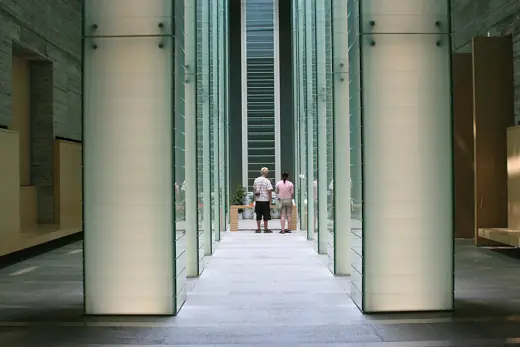
1/5 · Exterior · 9/11 Memorial and MuseumPhoto: Paul Sableman · CC BY 2.0 · source2/5 · Exterior · 9/11 MemorialPhoto: Paul Sableman · CC BY 2.0 · source3/5 · InteriorPhoto: Tdorante10 · CC BY-SA 4.0 · source4/5 · InteriorPhoto: Tdorante10 · CC BY-SA 4.0 · source5/5 · Detail · The brick pavement at the National 9/11 Memorial in New YorkPhoto: Farragutful · CC BY-SA 3.0 · source
Key featuresTwo square voids on the tower footprints with water falling into a further central drop.
About the building
In January 2004 the LMDC's design competition picked Reflecting Absence, by Michael Arad, an architect at Handel Architects, and the landscape architect Peter Walker, from 5,201 entries sent from 63 countries. The New York memorial sets two pools of about one acre (4,000 m²) each where the Twin Towers stood, standing for the lives lost and the void left behind. Their waterfalls, the largest built by people in the United States, are meant to soften the city's noise and make the site contemplative. Around the pools, 152 bronze parapets carry 2,983 names: 2,977 people killed on September 11 and six in the 1993 World Trade Center bombing. Over 400 swamp white oaks stand in rows across the plaza above the Memorial Museum, forming loose clusters, clearings and groves. It was dedicated on 11 September 2011 and opened a day later.
Portrait: Urban Land Institute · CC BY 2.0 · source
About National September 11 Memorial
The National September 11 Memorial & Museum (also known as the 9/11 Memorial & Museum) is a memorial and museum that are part of the World Trade Center complex, in New York City, created for remembering the September 11, 2001, terrorist attacks which killed 2,977 people, as well as the February 26, 1993, World Trade Center bombing which killed six. The memorial is located at the World Trade Center site, the former location of the Twin Towers that were destroyed during the September 11 attacks. It is operated by a non-profit institution whose mission is to raise funds to program and operate the memorial and museum at the World Trade Center site.
Designed by Davis Brody Bond, the museum is about 70 feet (21 m) below ground and accessible through a pavilion designed by Snøhetta. The National September 11 Memorial Museum encloses 110,000 square feet (10,000 m2) of publicly accessible space. The pavilion has a deconstructivist design, resembling a partially collapsed building (mirroring the attacks), and houses two "tridents" from the Twin Towers. One of the museum's walls is an exposed side of the slurry wall retaining the Hudson River, which remained intact through the September 11 attacks. About half of what Daniel Libeskind originally wanted to preserve of the wall is visible in the museum.