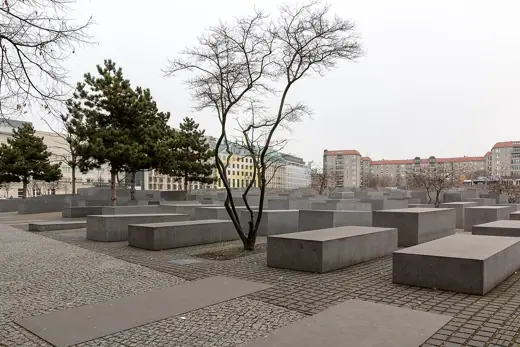
1/6 · Detail · Memorial to the Murdered Jews of Europe ( Peter Eisenman , 2005), Berlin , GermanyPhoto: Dietmar Rabich · CC BY-SA 4.0 · source2/6 · Exterior · Memorial to the Murdered Jews of Europe , BerlinPhoto: Photograph by Mike Peel ( www.mikepeel.net ) · CC BY-SA 4.0 · source3/6 · Exterior · Memorial to the Murdered Jews of Europe , BerlinPhoto: Photograph by Mike Peel ( www.mikepeel.net ) · CC BY-SA 4.0 · source4/6 · Exterior · Berlin-Mitte, Memorial to the Murdered Jews of Europe, taken from Cora Berlinner StraßePhoto: Michielverbeek · CC BY 4.0 · source5/6 · Interior · Photo from the inside of the Memorial to the Murdered Jews of EuropePhoto: Henn Racing · CC0 · source6/6 · Interior · Photo from the inside of the Memorial to the Murdered Jews of EuropePhoto: Henn Racing · CC0 · source
Key featuresA field of 2,711 concrete stelae of varying height on undulating ground, forming narrow aisles.
About the building
Often simply called the Holocaust Memorial, this Berlin memorial remembers the Jews murdered by Nazi Germany. Peter Eisenman designed it with Buro Happold for a site in Mitte, one block south of the Brandenburg Gate. On a sloping 1.9-hectare site stand 2,711 concrete stelae laid out on a grid. Each is 2.38 m by 0.95 m, and they rise anywhere between 0.2 and 4.7 m, so long, narrow, straight alleys run between them over rolling ground. In Eisenman's own text, the stelae are meant to create an uneasy, confusing mood, picturing a seemingly ordered system cut off from human reason. An underground "Place of Information" lists about 3 million victims' names, from Yad Vashem. Built in 2003–2004, it was inaugurated on 10 May 2005, six decades after the Second World War ended in Europe.
The Memorial to the Murdered Jews of Europe (German: Denkmal für die ermordeten Juden Europas), also known as the Holocaust Memorial (German: Holocaust-Mahnmal), is a memorial in Berlin to the Jewish victims of the Holocaust committed by Nazi Germany, designed by architect Peter Eisenman and Buro Happold. It consists of a 1.9-hectare (4.7-acre) site covered with 2,711 concrete slabs or "stelae", arranged in a grid pattern on a sloping field. The original plan was to place nearly 4,000 slabs, but after the recalculation, the number of slabs that could legally fit into the designated areas was 2,711. The stelae are 2.38 m (7 ft 9+1⁄2 in) long, 0.95 m (3 ft 1+1⁄2 in) wide and vary in height from 0.2 to 4.7 metres (8 in to 15 ft 5 in). They are organized in rows, 54 of them going north–south, and 87 heading east–west at right angles but set slightly askew. An attached underground "Place of Information" (German: Ort der Information) holds the names of approximately 3 million Jewish Holocaust victims, obtained from the Israeli museum Yad Vashem.