

Workplace · Brutalism
Mäusebunker
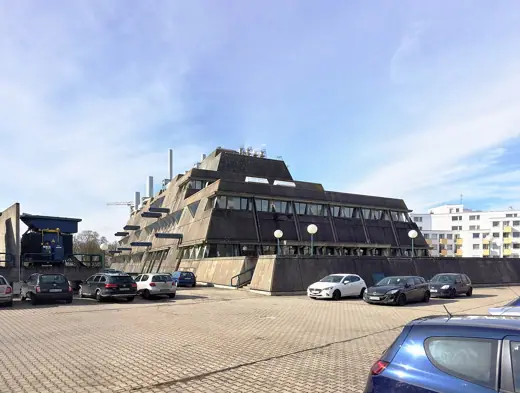
Key featuresA battleship-like concrete wedge of sloped walls bristling with blue ventilation pipes and angled windows.
About the building
Mäusebunker, or Mouse Bunker, is the everyday name for Berlin's Research Institutes for Experimental Medicine. It was built for live animal testing, and the animals used were also bred inside, to keep conditions sterile and control as tight as possible. The husband-and-wife team Gerd and Magdalena Hänska began designing it in the years 1965 to 1967, and from 1971 to 1981 Gerd Hänska, working with Kurt Schmersow, carried out the detailed planning and construction. The building was controversial from the start: the public disliked both its sinister look and its use for animal testing. Many international publications have shown it as a leading example of brutalism in Germany. After years of debate it gained protection as a heritage site in May 2023.
Sources: Research Institutes for Experimental Medicine (Wikipedia)
More with exposed concreteAll 542 →


Find more with
Exposed concrete542 buildings →Sculptural form769 buildings →Monumentality909 buildings →Workplace163 buildings →Each opens every building that shares the idea.
Details
- Architect
- Gerd and Magdalena Hänska
- Place
- Berlin, Germany
- Year
- 1981
- Typology
- Workplace
- Movement
- Brutalism
- Region
- Europe