




Library · Regionalism
Matenadaran
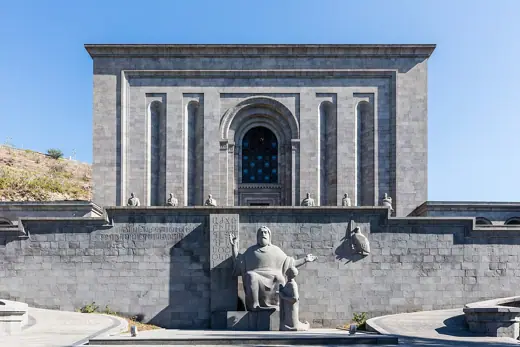
Key featuresA basalt manuscript archive with a deep arched portal set into the hill above a statue-lined stair.
About the building
The Matenadaran in Yerevan is the largest centre for keeping, studying and sharing Armenian manuscripts, acting as museum, archive and research institute. In October 1939, soon after the decision to bring the manuscripts to Yerevan, the Soviet Armenian authorities asked the city's chief architect, Mark Grigorian, to design it. Building ran from 1945 to 1957–58, halted from 1947 to 1953 for lack of skilled workers, and the interiors were finished between 1957 and 1959. A plain cube 22.4 m tall, faced in local grey basalt, it sits on a slope at the north-eastern end of Mashtots Avenue and closes the view along it. Grigorian wanted national architecture expressed as strongly as possible: the tall arched entrance between two narrow niches follows the 12th-century gavit of the Holy Apostles church at Ani, and the interior also draws on medieval gavits.
Sources: Matenadaran (Wikipedia)
More with stoneAll 524 →
Find more with
Stone524 buildings →Monumentality909 buildings →Axis319 buildings →Library144 buildings →Each opens every building that shares the idea.
Details
- Architect
- Mark Grigorian
- Place
- Yerevan, Armenia
- Year
- 1959
- Typology
- Library
- Movement
- Regionalism
- Region
- Middle East

Go deeper





See all 8 links


Portrait: David Dovlatyan (HayPost) · Public domain · source