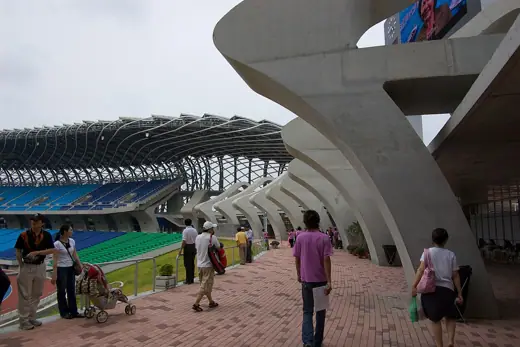
1/6 · Exterior · World Games StadiumPhoto: rido-lin · CC BY 2.0 · source2/6 · Exterior · World Games Stadium 2009Photo: sanbeiji's · CC BY-SA 2.0 · source3/6 · Exterior · World Games StadiumPhoto: rido-lin · CC BY 2.0 · source4/6 · Exterior · World Games Stadium under construction in 2008Photo: Joe Lewis · CC BY-SA 2.0 · source5/6 · Context · The Main Stadium for 2009 World Games panorama after 2009 World Games finishedPhoto: Solomon203 · CC BY 3.0 · source6/6 · ContextPhoto: Solomon203 · CC BY 3.0 · source
About National Stadium, Kaohsiung (World Games Stadium)
The National Stadium (Chinese: 國家體育場; pinyin: Guójiā Tǐyùchǎng; also named 龍騰體育場), formerly known as the World Games Stadium, is a multi-purpose stadium in Zuoying District, Kaohsiung, Taiwan. It is currently the largest stadium in Taiwan in terms of capacity.
Completed in 2009, it is used mostly for football matches and it hosted the main events for the 2009 World Games. The stadium has a capacity of 55,000 people. Since the conclusion of the games, the stadium has been used for selected Chinese Taipei national football team matches including FIFA World Cup qualifiers.
The stadium, designed by Japanese architect Toyo Ito, makes use of 1 MW of solar cells to provide most of its power needs. The stadium's semi spiral-shaped, like a dragon, is the first stadium in the world to provide power using solar power technology. The solar panels covering the vast external face of the stadium are able to generate most of the power required for its own operation, as well as additional power that can be sent to the grid.