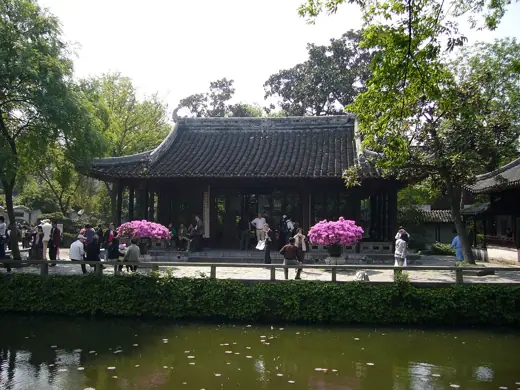
1/6 · InteriorPhoto: Pvt pauline · CC BY-SA 3.0 · source2/6 · Interior · Hall of Elegance, Humble Administrator's Garden , Suzhou , ChinaPhoto: King of Hearts · CC BY-SA 4.0 · source3/6 · Interior · Only 12 tourists inside, and there are some security officers to keep the orderPhoto: Shwangtianyuan · CC BY-SA 4.0 · source4/6 · Interior · Hall of Distant Fragrance, interieurPhoto: Pvt pauline · CC BY-SA 3.0 · source5/6 · Detail · Details of architecture in Humble Administrator's GardenPhoto: 韩笃一 · Public domain · source6/6 · Context · Le jardin de l'humble administrateur à SuzhouPhoto: Pascal3012 · CC BY-SA 3.0 · source
Key featuresPavilions, galleries and rockeries set around ponds so views unfold along a winding path.
About the building
A garden first stood on this site under the Southern Song dynasty, in its Shaoxing period (1131–1162). In 1513 Wang Xianchen, a Ming dynasty imperial envoy and poet, laid out a new one where the run-down Dahong Temple had stood, burnt during the Ming conquest. The work went on until 1526. Its name, recorded from around 1517, comes from a verse in An Idle Life by Pan Yue, a Jin dynasty scholar official. Wen Zhengming wrote an essay on the garden and, in 1533, honoured it with a set of 31 paintings and poems. Covering 78 mu (5.2 hectares, or 13 acres), it is the biggest garden in Suzhou, and some judge it the finest in southern China. Since 1997 it has been one of Suzhou's Classical Gardens, a UNESCO World Heritage Site.
The Humble Administrator's Garden is a Chinese garden in Suzhou, a UNESCO World Heritage Site and one of the most famous of the gardens of Suzhou. The garden is located at 178 Northeast Street (东北街178号; 東北街178號), Gusu District.
The garden contains numerous pavilions and bridges set among a maze of connected pools and islands. It consists of three major parts set about a large lake: the central part (Zhuozheng Yuan), the eastern part (once called Guitianyuanju, Dwelling Upon Return to the Countryside), and a western part (the Supplementary Garden). The house lies in the south of the garden. In total, the garden contains 48 different buildings with 101 tablets, 40 steles, 21 precious old trees, and over 700 Suzhou-style penjing/penzai. According to Lou Qingxi, compared with the layout from the Zhenghe period in the Ming dynasty, the garden "now has more buildings and islets", and although lacks a "lofty" feeling, it is "still a masterpiece of meticulous work". Liu Dunzhen judged that the arrangement of rocks and water in the ponds of the central third may have its origins in the early Qing. The western third retains the late nineteenth-century layout, while the eastern third has seen several renovation since.