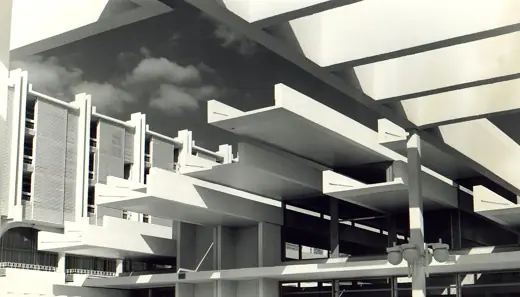
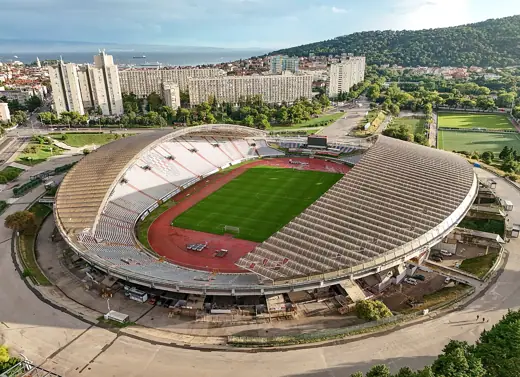
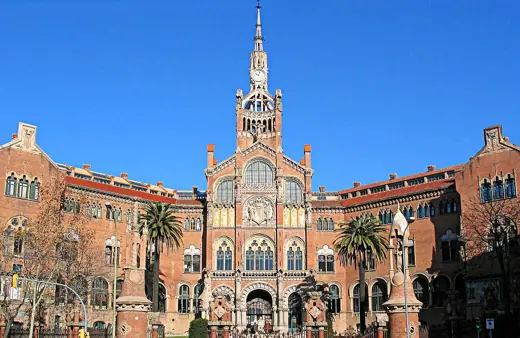
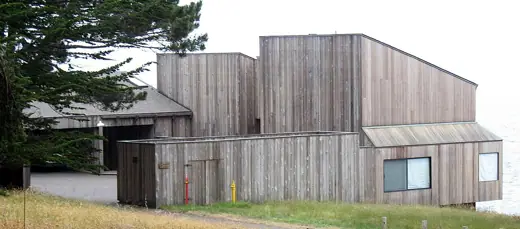
1/5 · Exterior · The Haludovo Hotel Palace was designed by architect Boris Magaš in 1969 and completed in 1972Photo: Boris Magaš · CC BY-SA 4.0 · source2/5 · Exterior · The Haludovo Hotel Palace was designed by architect Boris Magaš in 1969 and completed in 1972Photo: Boris Magaš · CC BY-SA 4.0 · source3/5 · Exterior · Haluvodo Palace Hotel 2026Photo: Laserlicht · CC BY-SA 4.0 · source4/5 · Exterior · Haluvodo Palace Hotel 2026Photo: Laserlicht · CC BY-SA 4.0 · source5/5 · Interior · The Haludovo Hotel Palace was designed by architect Boris Magaš in 1969 and completed in 1972Photo: Boris Magaš · CC BY-SA 4.0 · source
Key featuresA 'hotel city': varied building types spread through existing vegetation and linked by walkways; 1969–72.
About the building
The Haludovo Palace Hotel was the architectural and social heart of Haludovo, a resort at Malinska designed by the Croatian architect Boris Magaš and built from 1969 to 1972, as tourism on the Yugoslav Adriatic boomed. Covering about 25 hectares, Haludovo was planned as a self-contained tourist town rather than one hotel. The Palace held the commanding place of a castle, long blocks of rooms at the edge read as city walls, and clusters of small atrium villas formed a settlement inside. Shared rooms centred on a double-height atrium ringed by a gallery, where tall, thin concrete columns branched into arches. Similar concrete forms recur across the site as pergolas, sunshades and roofs. Guccione set up the Penthouse Adriatic Club in the Palace, with a casino aimed mainly at foreign guests. Historians count Haludovo among Magaš's key works.
The Haludovo Palace Hotel is an abandoned resort hotel near Malinska on the island of Krk, Croatia. It formed the architectural and social centre of Haludovo, a large tourist resort designed by Croatian architect Boris Magaš and constructed between 1969 and 1972 during the rapid expansion of tourism on the Yugoslav Adriatic.
Covering approximately 25 hectares (62 acres), Haludovo was conceived as a self-contained tourist settlement rather than a single hotel. In addition to the Palace, it included Hotel Tamaris, groups of atrium and two-storey villas, the coastal Fishermen's Village, and extensive sports, leisure and service facilities. The first phase was designed for approximately 1,650 guests, while the original planning concept envisaged an eventual capacity of about 5,000 beds.
Haludovo gained international attention in 1972 through a short-lived partnership between the Rijeka-based Yugoslav trading company Brodokomerc and American publisher Bob Guccione, founder of Penthouse. Guccione established the Penthouse Adriatic Club within the Palace, including a casino intended primarily for foreign visitors. The partnership ended the following year amid financial difficulties, but Haludovo continued operating as a conventional holiday resort throughout the 1970s and 1980s.