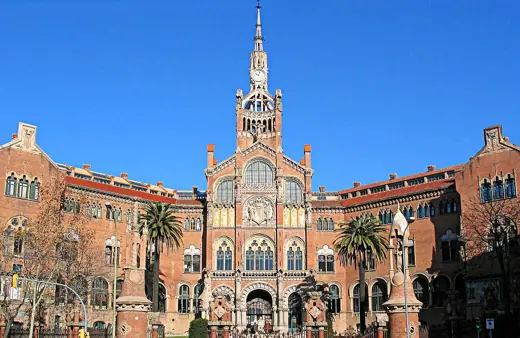
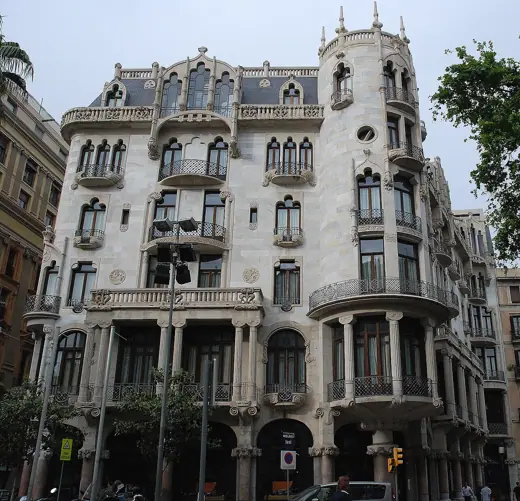
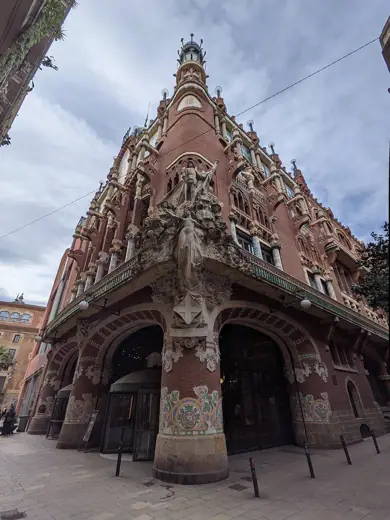
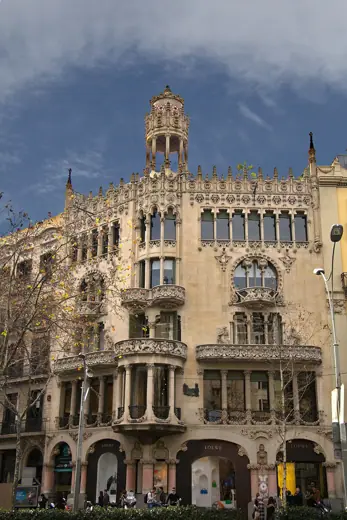
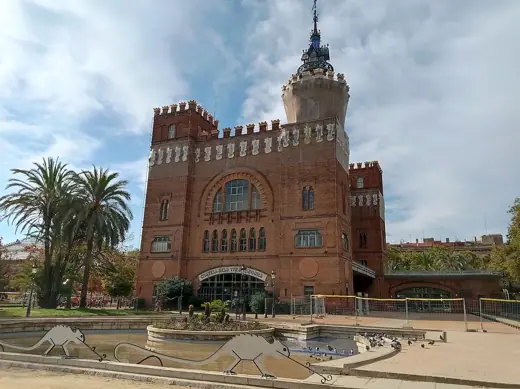
1/7 · Exterior · San Pau HospitalPhoto: Matinibz · CC BY-SA 3.0 · source2/7 · ExteriorPhoto: Txllxt TxllxT · CC BY-SA 4.0 · source3/7 · ExteriorPhoto: Txllxt TxllxT · CC BY-SA 4.0 · source4/7 · ExteriorPhoto: Txllxt TxllxT · CC BY-SA 4.0 · source5/7 · Interior · Vue de l'intérieur d'un bâtiment de l'Hospital de la Santa Creu i Sant PauPhoto: Arthur Crbz · CC BY-SA 4.0 · source6/7 · DetailPhoto: Enfo · CC BY-SA 3.0 · source7/7 · SketchPhoto: Lluís Domènech i Montaner · Public domain · source
The former Hospital de la Santa Creu i Sant Pau (Catalan pronunciation: [uspiˈtal də lə ˈsantə ˈkɾɛw i ˈsam ˈpaw], English: Hospital of the Holy Cross and Saint Paul) in the neighborhood of El Guinardó, Barcelona, Catalonia, Spain, is a complex built between 1901 and 1930. It is one of the most prominent works of the Catalan modernisme architect Lluís Domènech i Montaner. The complex was listed as a Conjunto Histórico in 1978. Together with Palau de la Música Catalana, it was declared a UNESCO World Heritage Site in 1997.
Composed of 12 pavilions connected through long underground galleries within its large green space, Sant Pau is the largest complex built in Art Nouveau style. It was a fully functioning hospital until June 2009, when the new hospital opened next to it. It underwent restoration for use as a museum and cultural center, and re-opened in 2014. An important historical and architectural masterpiece, the building also offers workspace to high-profile social organizations such as the WHO, Banco Farmacéutico, Barcelona Health Hub, EMEA, UN-HABITAT and more. The cultural center also has a historical archive where records and documents of remarkable occurrences related to the hospital and the city can be found.