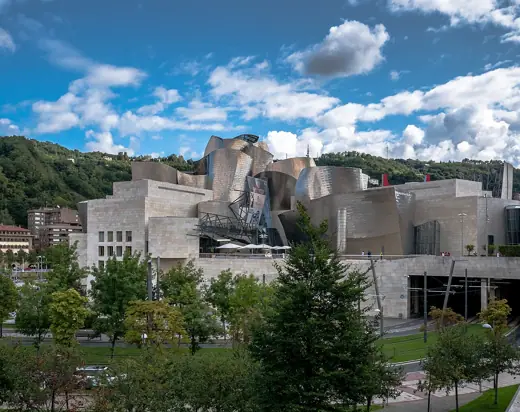
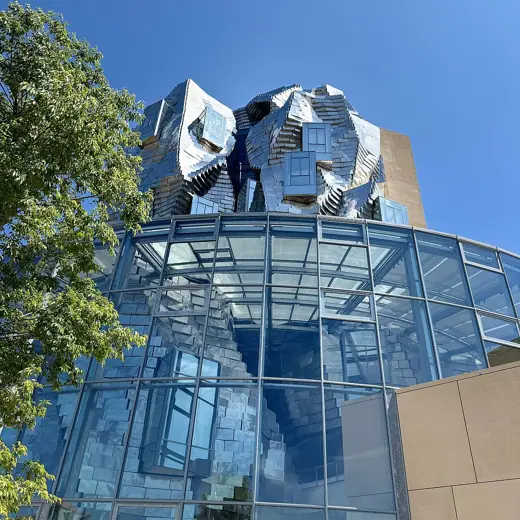
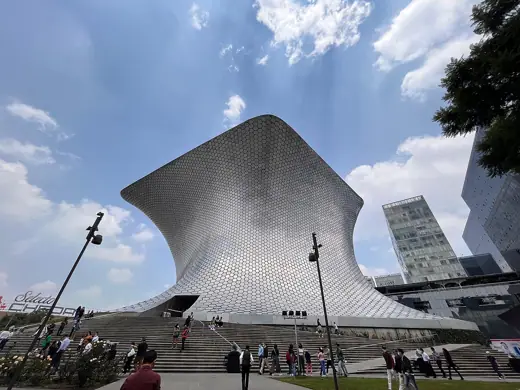
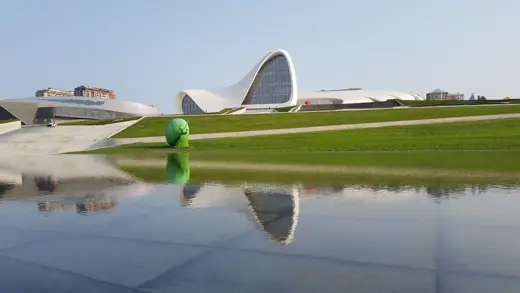
1/8 · Exterior · Guggenheim MuseumPhoto: Basotxerri · CC BY-SA 4.0 · source2/8 · Exterior · Guggenheim museumPhoto: PA · CC BY-SA 4.0 · source3/8 · Exterior · Guggenheim museum in Bilbao, SpainPhoto: Tiia Monto · CC BY-SA 3.0 · source4/8 · Exterior · Guggenheim Museum in BilbaoPhoto: Ermell · CC BY-SA 4.0 · source5/8 · Interior · Detail of the Guggenheim Museum staircase, Bilbao, Spain (PPL3-Altered)Photo: Jules Verne Times Two · CC BY-SA 4.0 · source6/8 · Detail · Detail of the Guggenheim Museum in BilbaoPhoto: Ermell · CC BY-SA 4.0 · source7/8 · Detail · Detail of the Guggenheim Museum in BilbaoPhoto: Ermell · CC BY-SA 4.0 · source8/8 · Detail · Detail of the Guggenheim Museum entrance, Bilbao, Spain (PPL1-Corrected)Photo: Jules Verne Times Two · CC BY-SA 4.0 · source
Key featuresTitanium curves designed with CATIA, software from the aerospace industry.
About the building
Frank Gehry's Guggenheim Bilbao stands on the bank of the Nervion, the river that crosses Bilbao on its way to the Cantabrian Sea. The outer curves are meant to look random; Gehry said this randomness was "designed to catch the light". 33,000 titanium plates form the outer skin. Its atrium, called The Flower by Gehry for its shape, organizes the whole museum. Nineteen galleries hold 120,000 sq ft (11,000 m2) of exhibition space. Ten have a classic orthogonal plan and read from outside as stone-faced; the other nine are irregular and appear as swirling, titanium-clad organic forms. It opened as part of Bilbao's revitalisation, and its impact on the district became known as the Bilbao effect. The 2010 World Architecture Survey of experts named it more often than any other building as a major work completed since 1980.
Portrait: City of Toronto / Jose San Juan · Attribution · source
About Guggenheim Bilbao
The Guggenheim Museum Bilbao is a museum of modern and contemporary art in Bilbao, Biscay, Spain. It is one of several museums affiliated to the Solomon R. Guggenheim Foundation and features permanent and visiting exhibits of works by Spanish and international artists. It was inaugurated on 18 October 1997 by King Juan Carlos I of Spain, with an exhibition of 250 contemporary works of art. It is one of the largest museums in Spain.
The Solomon R. Guggenheim Foundation selected Frank Gehry as the architect, and its director, Thomas Krens, encouraged him to design something daring and innovative. The curves on the exterior of the building were intended to appear random; the architect said that "the randomness of the curves are designed to catch the light". The interior "is designed around a large, light-filled atrium with views of Bilbao's estuary and the surrounding hills of the Basque country". The atrium, which Gehry nicknamed The Flower because of its shape, serves as the organizing center of the museum.