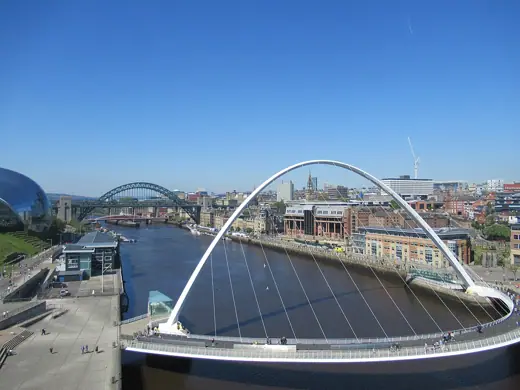
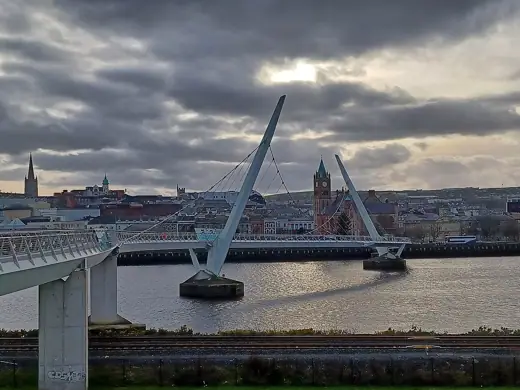
1/6 · ExteriorPhoto: Alex Liivet from Chester, United Kingdom · CC0 · source2/6 · Exterior · Such a beautiful day to grab a shot of the River Tyne's main attractions from the SagePhoto: Jatinder Dhillon · CC BY 2.0 · source3/6 · Exterior · This was taken when I was studying as a postgraduate student in Newcastle University, UKPhoto: Sraperfecta Audrey · CC BY-SA 4.0 · source4/6 · ExteriorPhoto: Benjamin Smith · CC BY-SA 4.0 · source5/6 · Detail · A close-up of the Pivots as the Gateshead Millennium Bridge opensPhoto: Xtrememachineuk ( talk ) ( Uploads ) · CC BY 2.5 · source6/6 · Detail · An artwork by Michael PinskyPhoto: Michael Pinsky · CC BY-SA 4.0 · source
The Gateshead Millennium Bridge is a pedestrian and cyclist tilt bridge spanning the River Tyne between Gateshead arts quarter on the south bank and Newcastle upon Tyne's Quayside area on the north bank. It was the first tilting bridge ever to be constructed. Opened for public use in 2001, the award-winning structure was conceived and designed by architectural practice WilkinsonEyre and structural engineering firm Gifford. The bridge is sometimes called the 'Blinking Eye Bridge' or the 'Winking Eye Bridge' due to its shape and its tilting method. The Millennium Bridge stands as the twentieth tallest structure in the city, and is shorter in stature than the neighbouring Tyne Bridge.
Gateshead Millennium Bridge was constructed to fulfil the following main design constraints: the bridge must be 4.5 metres (15 ft) above river-level during high spring tides when closed; nothing must be built on the Gateshead Quayside; the deck must have no more than a 1:20 slope to allow disabled access. The bridge consists of two steel arches – a deck which acts as the pedestrian and cycle path, and a supporting arch. The bridge was designed to be as light as possible to allow for easy opening and closing, so the two arches are lighter towards the centre span than at the hinges.