

Museum · Historic precedent
Egyptian Museum
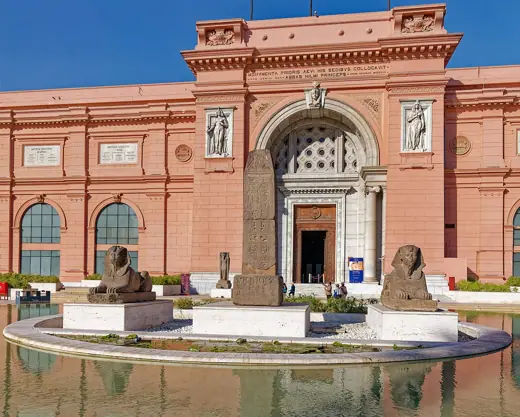
Key featuresNeoclassical facade; halls arranged in chronological sequence, statues on the ground floor, funerary items above.
About the building
After the Nile damaged the Boulaq Museum in 1878, Mariette, who thought it temporary, pressed for a larger, permanent museum away from the water's path. On 1 April 1897 the foundation stone of the new building on Tahrir Square was laid before Khedive Abbas Hilmi II, the Prime Minister and cabinet. The French architect Marcel Dourgnon designed it, the Italian firm of Giuseppe Garozzo and Francesco Zaffrani built it, and the German architect Hermann Grabe completed the project. The building is dated to 1901, and the collection was moved in during 1902. It was the Middle East's first national museum and is among Africa's largest. Its more than 170,000 objects form the world's largest collection of Egyptian antiquities, and the 42 ground-floor rooms show sarcophagi, boats and huge statues.
Sources: Egyptian Museum (Wikipedia)
More with monumentalityAll 909 →


Find more with
Monumentality909 buildings →Axis319 buildings →Circulation188 buildings →Museum735 buildings →Each opens every building that shares the idea.
Details
- Architect
- Marcel Dourgnon
- Place
- Cairo, Egypt
- Year
- 1902
- Typology
- Museum
- Movement
- Historic precedent
- Region
- Middle East