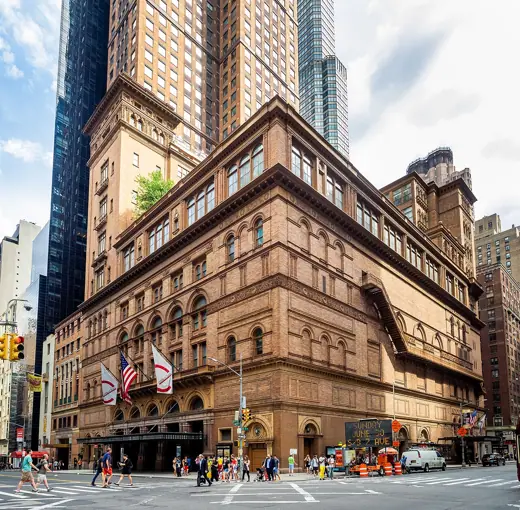
1/5 · Interior · Midtown Manhattan, NYCPhoto: Ajay Suresh from New York, NY, USA · CC BY 2.0 · source2/5 · Interior · Looking southeast at Carnegie Hall, at 7th Avenue and 57th Street in Midtown ManhattanPhoto: Tdorante10 · CC BY-SA 4.0 · source3/5 · Interior · Looking southeast at Carnegie Hall, at 7th Avenue and 57th Street in Midtown ManhattanPhoto: Tdorante10 · CC BY-SA 4.0 · source4/5 · InteriorPhoto: Tdorante10 · CC BY-SA 4.0 · sourcePhotos unavailable5/5Unknown artist Unknown artist · Public domain · source
Carnegie Hall ( KAR-nig-ee) is a concert venue at 881 Seventh Avenue, between 56th and 57th Streets, in Midtown Manhattan, New York City. Designed by architect William Burnet Tuthill and built by its namesake, industrialist and philanthropist Andrew Carnegie, the venue is one of the most prestigious in the world for both classical music and popular music. Carnegie Hall has its own artistic programming, development, and marketing departments and presents about 250 performances each season. It is also rented out to performing groups, though it has not had a resident company since the New York Philharmonic moved to Lincoln Center in 1962.
The Carnegie Hall complex has three auditoriums. The largest one is the Stern Auditorium, a five-story auditorium with 2,790 seats. Also part of the complex are the 599-seat Zankel Hall, located below ground on Seventh Avenue, as well as the 268-seat Joan and Sanford I. Weill Recital Hall on 57th Street. Besides the auditoriums, Carnegie Hall contains offices on its top stories.