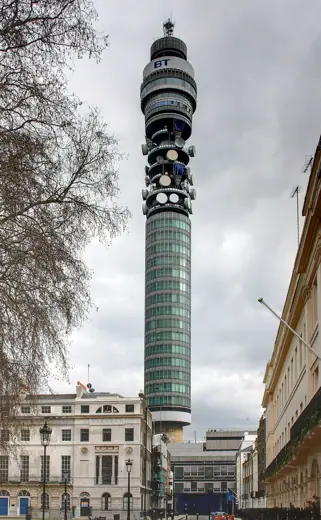
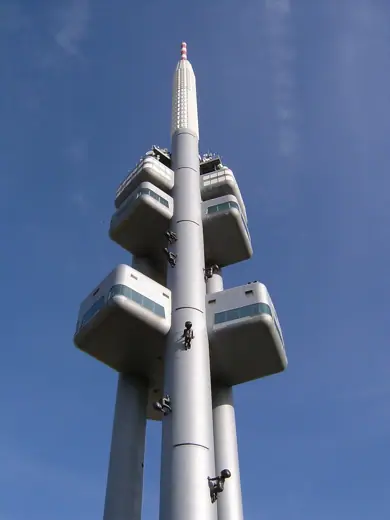
Key featuresCylindrical tower on a slim concrete core, its upper levels built for microwave antennas.
About the building
Rising over Fitzrovia in London, the BT Tower was completed in 1964 as a communications tower for the General Post Office. It replaced a lower 1940s steel lattice mast on top of the Museum Telephone Exchange, named for the nearby British Museum. The design came from the Ministry of Public Building and Works, led by Eric Bedford and G R Yeats as chief architects. The glass skin was tinted so the tower would not overheat. The first design called for a height of only 111 metres. The foundations go 53 metres down through London clay to a square concrete raft 27 metres across, strengthened with six layers of cables, with a reinforced concrete pyramid on top. On completion no structure in London stood taller, and it kept that title until 1980. It was listed Grade II in 2003.
Portrait: David Castor ( dcastor ) · Public domain · source
About BT Tower
The BT Tower is a communications tower in Fitzrovia, London, England, constructed in 1964. At the time of its completion it was known as the Museum Radio Tower, referring to its use by the neighbouring Museum Telephone Exchange. Subsequent changes in ownership caused it to become the Post Office Tower and Telecom Tower before it gained its current name in 1991. Since 2024 it has been owned by MCR Hotels. In 2003 Historic England designated it as a Grade II listed building.
The tower was commissioned by the General Post Office (GPO). Its primary purpose was to support the microwave aerials then used to carry telecommunications traffic from London to the rest of the country, as part of the GPO microwave network.
It replaced a shorter, 1940s steel lattice tower on the roof of the Museum Telephone Exchange, so named for its proximity to the British Museum. The taller structure was required to protect the radio links' line of sight against tall buildings then planned in London. Links were routed via GPO microwave stations Harrow Weald, Bagshot, Kelvedon Hatch and Fairseat, and locations including the London Air Traffic Control Centre.