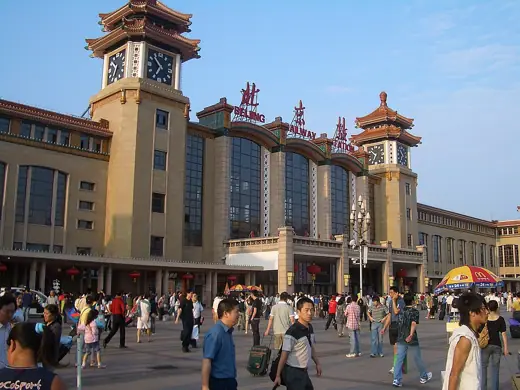
Key featuresLong station front with two clock towers and pavilion-roofed turrets, blending Chinese roofs with socialist realism.
About the building
In 1958 the Communist Party's Central Committee began planning ten large projects, the "Ten Great Buildings", to mark a decade of the People's Republic, and this station was among them. Work took a little over seven months and was finished on 10 September 1959. On opening that year it was the biggest train station in China and the country's first large modern railway terminal. The south-facing station house mixes Chinese traditional style with Soviet Stalinist architecture, visible in its gilded eaves and tall clock towers. While the design brief was being settled, Zhou Enlai suggested a turret on each wing of the main block, and his idea was adopted. Inside, twelve waiting rooms share 14,000 square metres of floor and could hold 14,000 waiting passengers.
Beijing railway station is a passenger railway station in Dongcheng District, Beijing. The station is located just southeast of the city centre inside the Second Ring Road with Beijing Station Street to the north and the remnants of the city wall between Chongwenmen and Dongbianmen to the south. The Beijing railway station opened in 1959 and was the largest train station in China at the time. Though superseded by the larger Beijing West and Beijing South stations, this station remains the only one located inside the old walled city. Trains entering and leaving the station pass by the Dongbianmen corner tower. With gilded eaves and soaring clock towers, the architecture of the railway blends traditional Chinese and socialist realist influence.
To commemorate the Tenth Anniversary of the founding of the People's Republic of China, the Central Committee of the Chinese Communist Party in 1958 began the planning and construction of ten large-scale projects, known as the "Ten Great Buildings" to showcase the new outlook of the country and the Beijing railway station was amongst the projects undertaken.