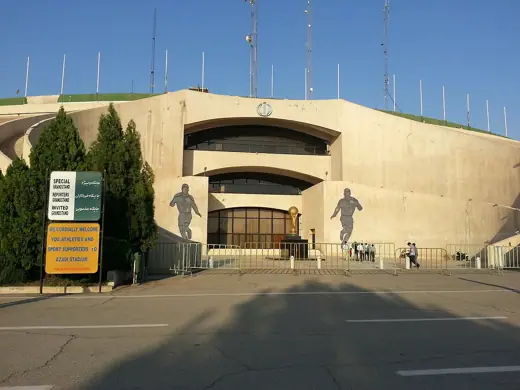
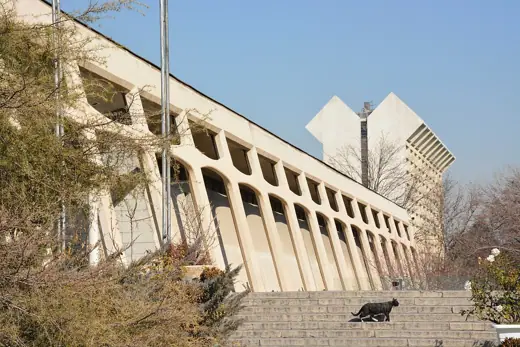
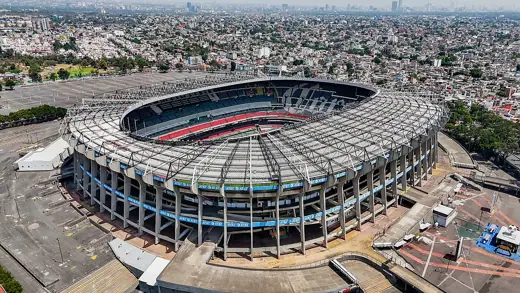
The Azadi Stadium, opened and also well known as the Aryamehr Stadium (Persian: ورزشگاه آریامهر, romanized: Varzeshgâh-e Âryâmehr), is an all-seater football stadium in Tehran, Iran. The stadium was designed by Abdol Aziz Mirza Farman-Farmaian Architects and Associates (AFFA), with other parts of the sports complex based on plans by American architectural and engineering firm Skidmore, Owings & Merrill. It currently has a capacity of 78,116 spectators, as a result of conversion to an all-seater stadium.
Originally named Aryamehr (lit. 'Light of the Aryans') after the title of the Shah, the stadium was inaugurated on 17 of October 1971 by Mohammad Reza Pahlavi, the late Shah of Iran, as part of the greater Aryamehr Sport Complex. Both stadium and complex were renamed after the 1979 Iranian Revolution to Azadi (meaning "freedom" in Persian).
The largest association football stadium in Western Asia, it was built to host the 1974 Asian Games and has hosted the 1976 AFC Asian Cup. The stadium has also hosted five finals of Asian Club Competitions: three finals of AFC Champions League in 1999, 2002 and 2018 and two finals of the Asian Cup Winners' Cup in 1991 and 1993. Azadi Stadium also hosted WAFF Championship Tournament in 2004 and 2008.