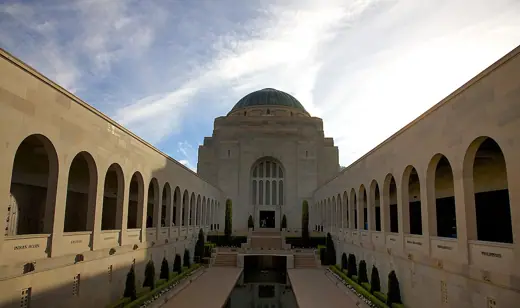
1/6 · Exterior · Australian War Memorial in CanberraPhoto: Capital photographer ( talk ) · CC BY-SA 3.0 · source2/6 · Exterior · Australian War Memorial - see www.joyofmuseums.comPhoto: GordonMakryllos · CC BY-SA 4.0 · source3/6 · ExteriorPhoto: Boyd159 · CC BY-SA 4.0 · source4/6 · Exterior · Australian War Memorial, January 2026Photo: DaHuzyBru · CC BY-SA 4.0 · source5/6 · Interior · An elevator in Anzac Hall at the Australian War MemorialPhoto: Nick-D · CC BY-SA 4.0 · source6/6 · Interior · The new entry foyer of the Australian War MemorialPhoto: Nick-D · CC BY-SA 4.0 · source
Key featuresCloistered courtyard and pool lead on axis to a domed Hall of Memory lined in mosaic.
About the building
The Australian War Memorial in Canberra is a national memorial, museum and archive for all Australians killed by war, peacekeeping included. Emil Sodersten and John Crust shared the design, asked to combine Sodersten's Art Deco manner with Crust's thrift. The Great Depression delayed building; the Memorial Building went ahead in the mid-1930s and opened in 1941. Its interlocking masses and front pylons carry Byzantine and Egyptian motifs in an Art Deco frame. It was set on an axis on purpose, to mark its national standing and give a clear line of sight to and from Parliament House. A courtyard with a reflecting pool leads up steps at its north end to the Hall of Memory, where Waller's mosaics, the largest murals in Australia, went in during 1955, and the Tomb of the Unknown Australian Soldier in 1993.
The Australian War Memorial (AWM) is a national war memorial, museum and archive dedicated to all Australians who have died as a result of war, including peacekeeping duties. The AWM is located in Campbell, a suburb of the Australian capital city of Canberra. The grounds include five buildings and a sculpture garden. Most of the museum galleries and commemorative areas are contained in the Memorial Building.
Plans to build a national war memorial and museum were initiated shortly after the First World War, with the AWM formally established through federal legislation in 1925. Designs for the AWM were created by Emil Sodersten and John Crust, although the onset of the Great Depression delayed its construction. Work on the Memorial Building progressed in the mid-1930s, and the AWM was officially opened to the public in 1941. Several structures designed by Denton Corker Marshall were built on the grounds from the 1980s to 2000s, to house additional museum exhibits and administrative offices. In 1993, the Tomb of the Unknown Australian Soldier was installed inside the Memorial Building's Hall of Memory.