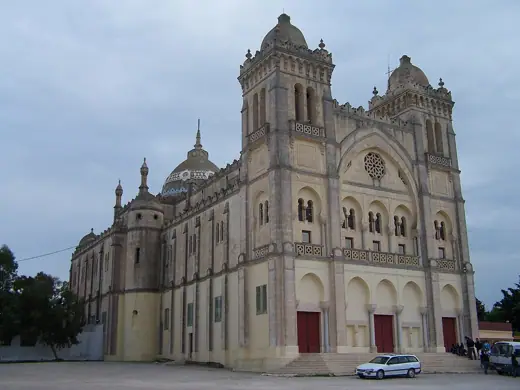
Key featuresByzantine, Gothic and Moorish styles; Latin cross plan, central cupola ringed by eight small spires.
About the building
The Acropolium, or Cathedral of Saint Louis, crowns Byrsa Hill in Carthage, Tunisia, near the ruins of the Punic, then Roman, city, over the remains of a temple to Eshmun, the Punic god of healing. Built in 1884–1890 under the French protectorate, it became the primatial church of all Africa when that title was revived for Cardinal Lavigerie. He dedicated it to Saint Louis, who died near this spot in 1270 during the Eighth Crusade. The abbot Pougnet drew the plans, mixing Byzantine, Gothic and Moorish ideas on a Latin cross 65 metres by 30. Two square towers frame the front; a large cupola ringed by eight short towers covers the crossing, and a smaller one tops the apse. It has 284 stained glass windows. Worship has ended, and it now hosts events and concerts of Tunisian and classical music.
About Acropolium of Carthage (Cathedral of Saint Louis)
The Acropolium, also known as Saint Louis Cathedral (French: Cathédrale Saint-Louis de Carthage), is a former Latin Catholic church located in Carthage, Tunisia.
Late 19th century French architecture tended to feature composite styles (as in the case of the Basilica of the Sacré Cœur in Paris, built in the Romanesque-Byzantine architectural tradition in the same era). The building, constructed according to the plans of the abbot Pougnet, is inspired by Byzantine, Gothic, and Moorish architectural style, and is in the shape of a Latin cross of 65 meters by 30. The façade is framed by two square towers, the crossing lies beneath a large cupola surrounded by eight short towers or spires, and there is a smaller cupola above the apse.
The church contains a nave and two aisles separated by arches passing above. The ceiling beams are sculpted, painted and gilt with arabesques. The church has 284 stained glass windows.
The church is home to artefacts, such as a monument in onyx holding the reliquary of Saint Louis, and mosaics of Saint Cyprien. Its great bell weighs six tons and there is a four-bell carillon as well. A cross, the only one standing at that time in Tunisia, tops the building.