Guide · Juries
What architecture jurors look for: a checklist from the other side of the table
Jurors rarely mark a project with a checklist, but many of them are asking the same quiet questions while you talk. Is there one clear idea? Do the drawings prove it? Do the plan, section and views agree with each other? Does the building answer its site and its users? Could it stand up? And does the student understand their own project when it is questioned? Here is each question, what a juror is looking at when they ask it, and how to check your own work against it before the jury.
How this differs from presentation tips
Our jury presentation tips are about how to talk. This guide is about what is being judged while you talk, so you can fix the project, not just the delivery. Run through it a few days before the jury, when there is still time to change a drawing.
1. Is there one clear idea?
The first thing a juror wants is a handle on the project: a sentence that explains most of the decisions. Without it, every drawing is just a drawing.
What they look at: the title area, the hero image and your first thirty seconds.
Check yourself: write the idea in one sentence on a card. Then point at five decisions in your plans and sections. If more than one or two can't be explained by that sentence, either the idea or those decisions need work.
2. Do the drawings prove the idea?
A strong idea that the drawings don't show reads as a slogan. If your idea is about light, a juror looks for the section that shows where the light comes from. If it is about a public ground floor, they look at the ground floor plan and its edges.
Check yourself: for your one sentence, name the drawing that proves it. If there isn't one, that drawing is your most important job before the jury, more important than another render.
3. Do the drawings agree with each other?
Jurors cross-check. They follow a stair in the plan and look for it in the section. They find the window in the render and look for it in the elevation. A column that appears in one drawing and not another, or a roof that changes shape between views, tells them the project isn't resolved yet.
Check yourself: print the plan and the section at the same scale and trace one route through both: entrance, stair, main room. Then compare every view with the plan: windows, columns, roof edges, levels.
4. Does it answer the site?
A project that could sit on any site is weaker than one that could only sit on yours. Jurors look for the moves that come from the place: the entrance on the street that people actually use, the building that steps with the ground, the courtyard placed for the sun, the tree that was kept.
Check yourself: list three things your design does because of this site. If you can't, revisit your site analysis and find the findings that should have shaped the plan.
5. Does it work for the people who use it?
Behind the idea, a juror is quietly walking through the building. Where do I enter? Where do I wait? Is that corridor too long, that room too dark, that stair too steep for the people in the brief? Are there toilets, storage, a service entrance, a way for a wheelchair user to get to every level?
Check yourself: follow two different users through your plans, for example a visitor and a member of staff, or a child and an older person. Mark anything that would annoy, exclude or endanger them.
6. Could it stand up and be built?
Studio juries don't expect engineering, but they do expect a believable structure. A cantilever with no visible support, a long span with no depth, or walls that don't line up between floors will draw a question.
Check yourself: colour the structure in your plans and section: columns, load-bearing walls, beams. Check that it lines up from floor to floor and that spans are reasonable for the material you have chosen. Be ready to say in a sentence how the roof is held up.
7. Is the scale right?
Rooms that are far too big or too small, stairs without enough length to climb the height, or doors that would be three metres wide at the drawn scale show that the drawings haven't been checked against a person.
Check yourself: put people in your sections and views at the correct size, and check a few key dimensions: a stair's going and rise, a corridor's width, a room's area against the brief.
8. Is the work honest about its process?
Jurors value seeing a turning point: the sketch where the idea arrived, the model that showed what didn't work. They lose trust when images don't match the drawings, or when generated images are presented as the student's design.
Check yourself: keep one or two process images that explain a decision, credit any AI-generated image on the board, and make sure every view matches your model and plans. Our roundup of AI tools covers using them honestly.
9. Is it presented with care?
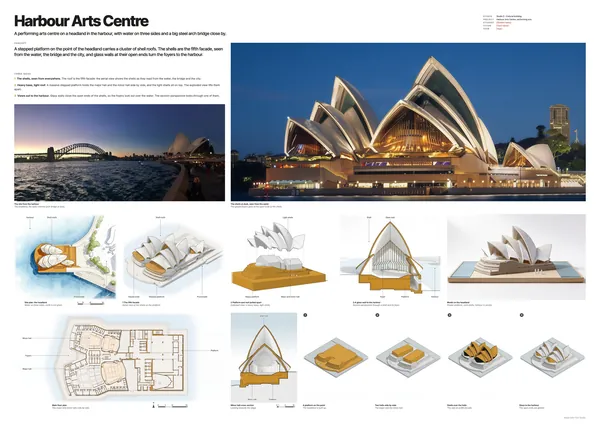
Presentation doesn't rescue a weak project, but a careless one hides a good project. Jurors notice a board that reads in the right order, drawings large enough to see, consistent line weights, labels on every drawing and captions that say what to look at.
Check yourself: stand three metres from a print of your board and ask a friend what the project is about. Then see laying out an A1 board and presenting plans and sections for what to fix.
10. Do you understand your own project?
Much of a jury's judgement is formed in the conversation after your talk. Jurors probe weak points on purpose, not to embarrass you but to see how you think. A student who says "you're right, the north rooms will be dark; I'd test a light well here" shows more than one who defends everything.
Check yourself: write down the five questions you'd most hate to be asked and answer each one aloud in two sentences. Ask a classmate to play a tough juror for ten minutes.
Using the checklist
Two or three days before the jury, go through the ten questions with your drawings in front of you and mark each one green, amber or red. Fix the reds that a drawing can fix (usually 2, 3 and 7), and prepare honest answers for the reds you can't fix in time. The 48-hour jury plan shows how to fit this in and still sleep.
If the design is ready but the presentation is the bottleneck, Studio FGA sets your own drawings on an A1 board and builds a matching jury deck from $6.49, and the time saved can go into the checks above.
Questions students ask
What do architecture jurors look for first?
A clear idea, usually read from the hero image, the title and your opening sentence. Then they look for the drawings that prove it, and check whether the plan, section and views agree with each other.
How are architecture juries graded?
It depends on your school, and many publish their criteria in the studio brief or handbook, so read them. Most look at the strength of the idea, how well the drawings develop and prove it, response to site and users, technical believability, the quality of the presentation, and how well you discuss the project.
What should I do if a juror says my project doesn't work?
Listen to the whole point, ask a short question if you need to understand it, and respond with how you would fix it. Jurors judge how you handle criticism as much as the project itself; agreeing with a real weakness and proposing a fix is a strong answer.