Guide · Juries
How to prepare for an architecture jury in 48 hours, without an all-nighter
The all-nighter before a jury feels like a rite of passage, but it mostly produces tired presentations of half-finished boards. Forty-eight hours is enough to present a project well if you stop designing at the start of them and spend the time on drawings, layout, printing and rehearsal, in that order, with a hard stop each night. Here is a plan that does that.
Hour zero: freeze the design
The most important decision comes first. From this point you are not designing; you are presenting the design you have. No new schemes, no moving the core, no "quick" change to the roof that ripples through every drawing.
This feels uncomfortable, because the project is never finished. But a jury responds far better to a clear presentation of a slightly unresolved scheme than to a messy presentation of a scheme that changed last night. Anything you would still like to change goes on a list called "next steps"; you'll mention it in your talk.
Hours 0 to 2: inventory and the one sentence
Sit down with the brief and make three lists:
- Required: every drawing, model and document the brief asks for, at the scales it asks for.
- Done: what already exists in a state you could show.
- Gap: the difference between the two.
Then write the idea of your project in one sentence. Then sketch the board as boxes on paper, numbered in the order you'll explain the project, and list your slides if you need a deck. This is two hours that saves twenty. Put every final file in one folder with clear names.
Day 1, morning: drawings to final standard
Bring the drawings in your "done" list up to presentation quality and fill the gaps that matter most. Work in order of importance: the hero image, then the plans and sections, then everything else.
Use one line-weight set, one poché approach and one label style across every drawing, so they look like a family. Add scale bars, north points and section cut lines now, not during layout. How to present plans and sections covers the details.
Day 1, afternoon: lay out the board
Set up margins and a grid, place the hero, then place the rest in your reading order. Don't polish yet. The goal for this afternoon is a complete first draft of every board, with every drawing in roughly the right place and placeholder captions. A complete rough board is worth more than one perfect corner. How to lay out an A1 board walks through the grid and sizes.
If layout is the part that eats your time, Studio FGA can draft an A1 board and a jury deck from your drawings, which you then check and adjust; the checking still needs your eyes and a little time.
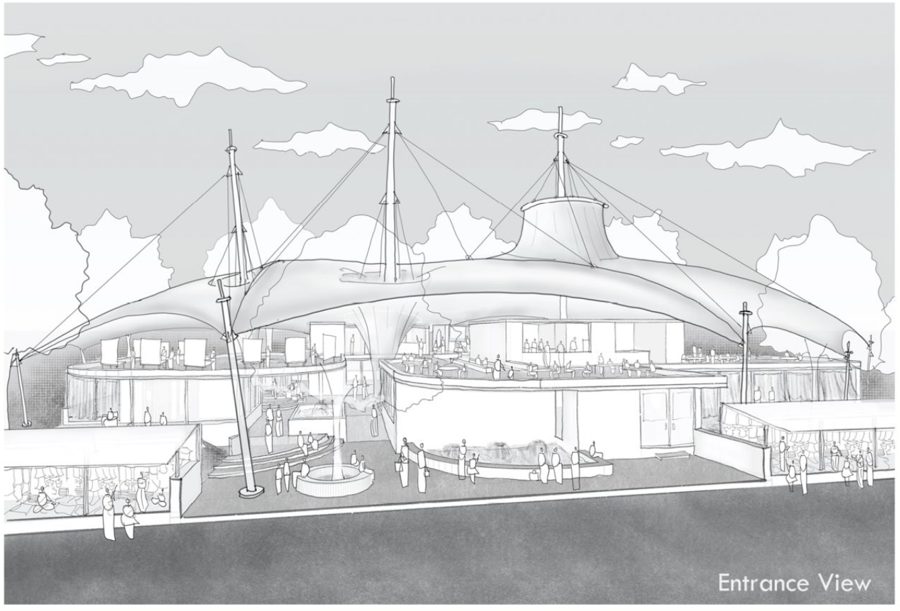
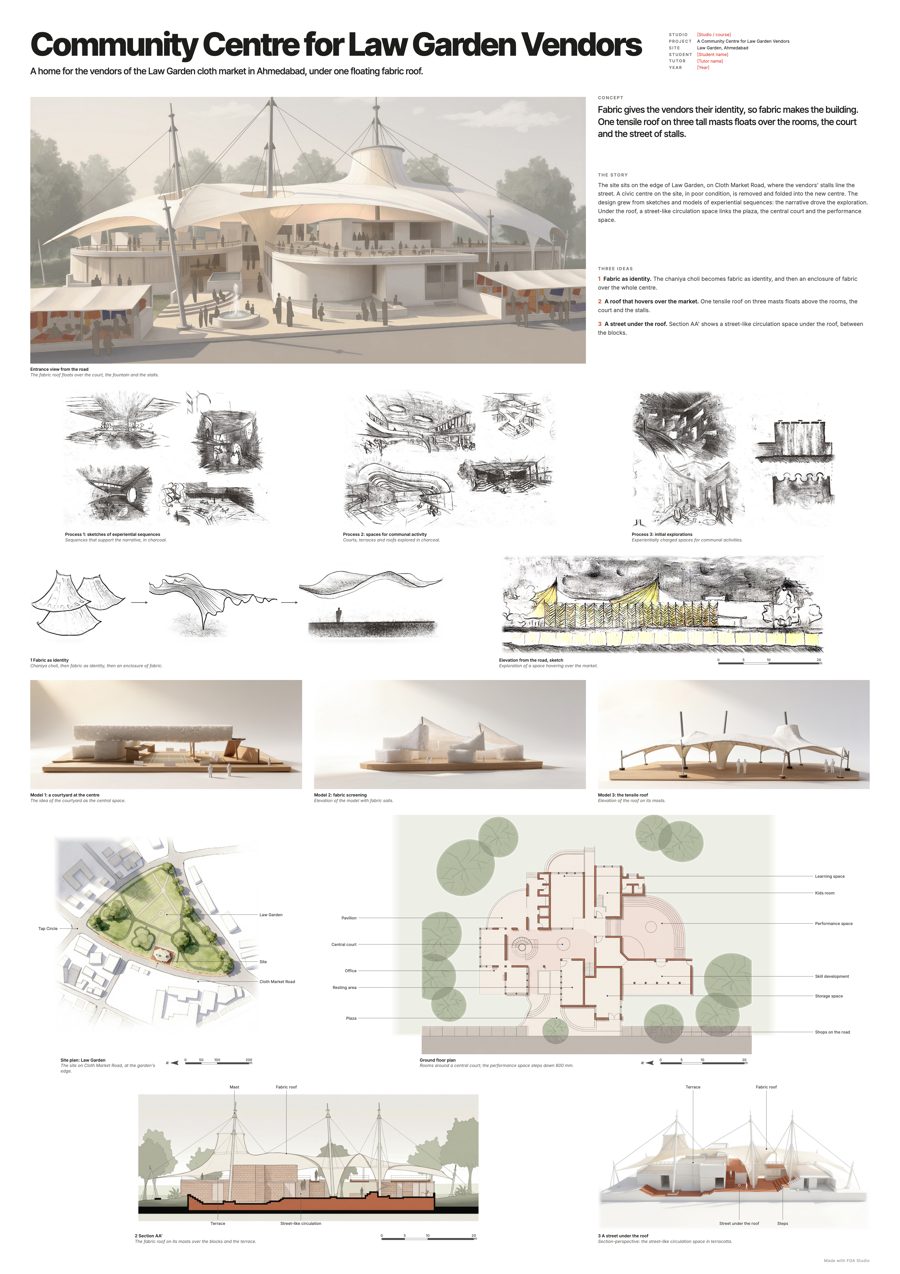
Day 1, evening: print at A3 and stop
Print each board at A3, which is exactly half of A1 in each direction. Pin the prints on a wall, step back two metres and look. What do you see first? Does the order make sense? Can you read the captions? Is there a drawing that doesn't earn its place?
Write a list of fixes on the print itself. Then stop, at a time you set in advance. You will fix the list faster and better in the morning than at midnight.
Day 2, morning: fixes, text and the deck
Work through the fix list from the A3 prints. Write the final captions: one or two lines each, saying what to look at, not what the drawing is. Check every number on the board against your drawings: areas, levels, dimensions and dates.
If you present slides, build the deck now, following the board's order with the same drawings and the same words. A 10–15 slide outline is in how to structure a jury deck. Photograph your model in daylight against a plain background if you haven't already.
Day 2, midday: plot early
Send boards to print by early afternoon at the latest. Print shops near architecture schools tend to be busiest in the hours before reviews, and a plot that comes out wrong needs time to redo.
Before sending:
- Export PDFs at the exact sheet size, with fonts embedded and images at a resolution suitable for the print size.
- Check the PDF, not the working file, at 100% zoom in a few places.
- Ask the shop about their margins, paper and any colour settings they prefer.
- Keep copies of the final PDFs on a USB stick and in cloud storage.
Check the plots when you collect them, while there is still time to reprint.
Day 2, afternoon: rehearse
Rehearse the presentation out loud, standing up, with a timer, at least twice. Start with the one-sentence idea, then walk through the board in order. If you overrun, cut, don't speed up.
Then write down the five questions you'd least like to be asked, and answer each in a sentence or two. Usually you already know where the project is weak; preparing an honest answer is better than hoping nobody notices. Jury presentation tips covers handling questions.
Day 2, evening: pack and sleep
Pack everything the night before:
- Boards, rolled or in a folder, plus the PDFs on a USB stick.
- Model, with a box or board to carry it safely.
- Pins, tape or clips, whichever your studio uses.
- Laptop, charger, and an adapter for the projector or screen.
- A small card with your opening sentence and the order of your talk.
- Water, and something to eat.
Then sleep. You'll think and answer questions far better rested, and you have nothing left to do.
The morning of the jury
Arrive early enough to pin up without rushing. Once your boards are up, step back and look at them as a juror would. Straighten anything crooked. Watch one or two presentations before yours if you can; you'll get a sense of what the jury is asking about.
If you're behind schedule
If day one runs late, cut in this order: first, extra renders beyond the hero; then process work; then secondary details. Never cut the hero image, the main plans and sections, or the rehearsal. A clear board with fewer drawings, presented by someone who has slept, beats a full board presented by someone who hasn't.
Questions students ask
Is it OK to present an unfinished project at a jury?
Yes, if you present it clearly and say what is unresolved and how you would develop it. Juries generally respond better to an honest, well-presented scheme than to a rushed one.
How early should I print my boards before a jury?
Aim to send them to print by early afternoon the day before, so there is time to check the plots and reprint anything that comes out wrong.
How do I avoid an all-nighter before a jury?
Freeze the design 48 hours before, spend day one on drawings and a complete rough layout, print at A3 to check, plot early on day two, rehearse, and set a hard stop each night.