Guide · Juries
12 architecture jury presentation ideas that make a project stick
Many jury presentations sound alike: site, brief, concept, plans, sections, render, "thank you". The projects that jurors remember are usually told through one device that suits the idea: a walk through the building, the same view before and after, one big section, a model they can hold. Below are twelve such devices. Pick one or two that fit your project, build the board and the talk around them, and leave the rest.
How to use this list
These are not tricks to dress up a weak scheme. Each one is a way of putting your strongest evidence in front of the jury early, so the conversation is about your idea and not about finding it. Before you choose, write your idea in one sentence (our jury presentation tips explain why that matters), then ask which device proves that sentence fastest.
A useful test: if the device would work equally well for any project in your studio, it is decoration. If it only makes sense for yours, it is an idea.
1. The walk-through
Tell the building as a person moving through it: arriving from the street, passing the threshold, turning, climbing, arriving at the main room. Lay the plans and sections so the route reads across the board, and number the stops on the plan so you can point at "one", "two", "three" as you talk.
Suits projects about sequence and arrival: museums, libraries, religious buildings, houses on difficult sites. It turns a list of drawings into a story with a beginning and an end.
2. The same view, before and after
Take a photograph of the site from one point, then show your building from exactly the same point, same height, same lens. Pin them side by side. The jury sees in one glance what you changed and what you kept.
Suits projects in existing contexts: infill, adaptive reuse, landscape, anything where respecting the place is part of the argument. Shoot the "before" on your site visit, standing where a real person would stand, not from a drone you didn't have.
3. One section that carries the project
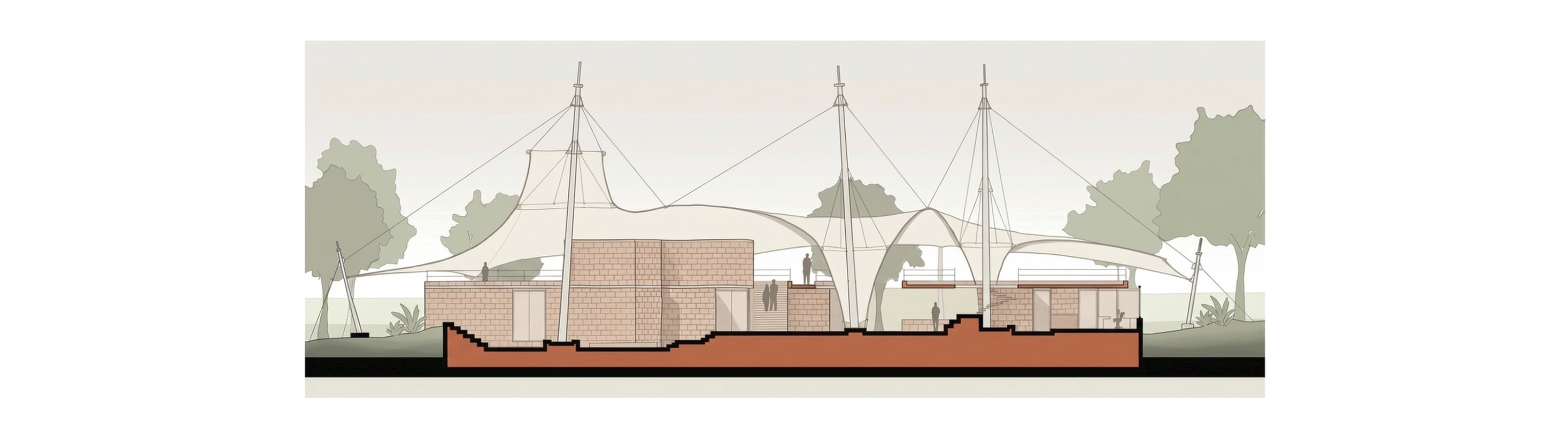
Choose the cut that explains the most: through the main space, the light, the ground and the street together. Draw it large, up to the full width of the board, and put people, furniture and daylight in it. Then let every other drawing support it.
Suits projects whose idea lives in the vertical: a courtyard that brings light down, a building that steps with the ground, a roof that does the work. Presenting plans and sections covers line weights and poché for a section this size.
4. The model on the table
A physical model invites jurors to lean in, pick it up and look underneath, and that changes the tone of the conversation. Bring it to the front, not to a shelf at the back. A sectional model that opens, or a roof that lifts off, gives you a natural moment in the talk: "and when you take the roof away…".
Light it on purpose. A phone torch held low across a massing model shows morning shadows in a few seconds and costs nothing.
5. The zoom-in
Start at the scale of the city or the neighbourhood, then step in: the street, the site, the building, one room, one detail. Five drawings at five scales, laid out as a strip from large to small. Each step should answer a question the previous one raised.
Suits urban and campus projects, and any project where the reason for a detail sits far away (a breeze, a view, a route). Keep every step at a clearly marked scale, or the zoom becomes confusing rather than revealing.
6. Three to five moves
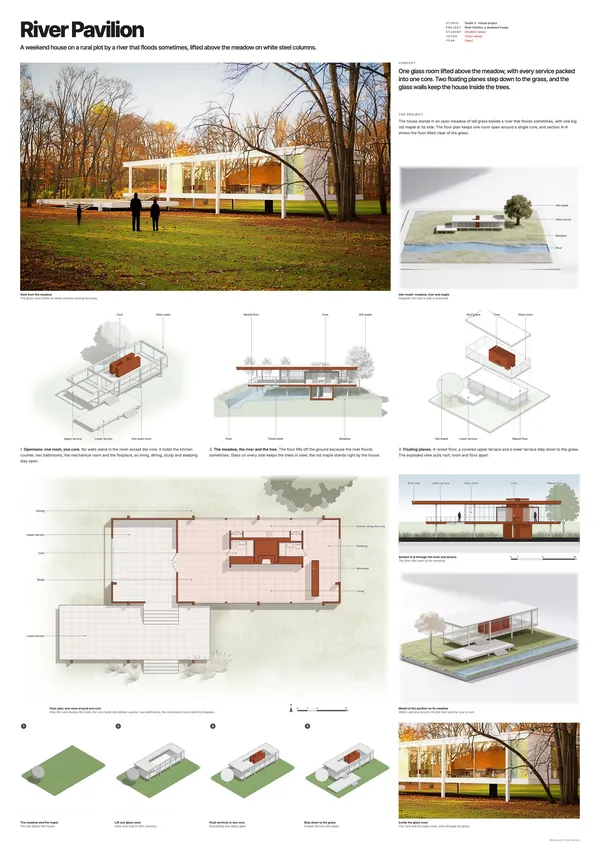
Show how the form came about in a short row of massing diagrams: the plain volume the site allows, then each design move in turn (cut, lift, split, turn), each with a two- or three-word label. The jury follows your reasoning instead of having to guess it from the final form.
Suits projects with a strong formal idea. Keep it to the real moves, in the order you made them. Five honest steps beat twelve that show every version you tried.
7. A day, or a year, in the building
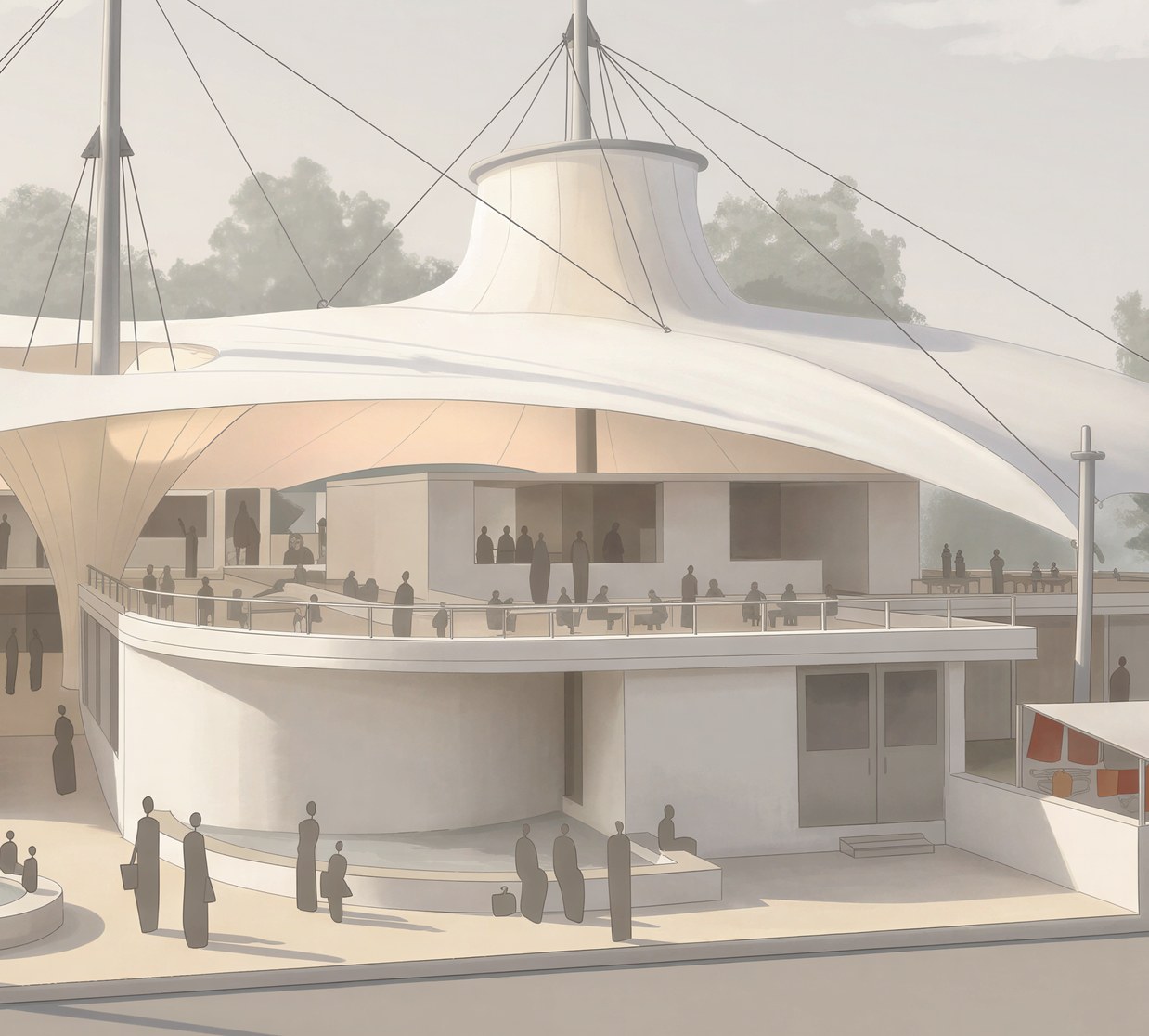
Show the same space at three times: morning, midday and evening, or summer and winter. Light, shade, how many people are there, what they are doing. A row of three small perspectives or sections makes the case that you thought about the building in use, not just as an object.
Suits climate-led projects, public spaces, markets, schools: anything whose life changes with the hours or the seasons.
8. One person's story
Follow one kind of user through the building: a vendor setting up a stall at dawn, a student arriving at a library, a patient waiting for an appointment. This is a design device, not a testimonial, so present it as your scenario. It makes jurors judge the building at the scale of a body: how far is the walk, where is the shade, where do you wait.
Suits briefs with a clear user group, and social projects where the brief itself is about people.
9. Start with the problem
Open on the thing the project fixes, shown plainly: a photograph of the flooded street, a diagram of the noise, a plan of the dark interior of the old block. Then show your answer. A jury that has seen the problem judges the solution against it, which is exactly the judgement you want.
Suits research-led and thesis projects, retrofits, and any project born from a site visit that showed you something.
10. A precedent at the same scale
Put one precedent beside your project, drawn at the same scale and in the same style: two plans side by side, or two sections. Say in one sentence what you took and what you did differently. This shows that you read architecture, and it answers the question "have you looked at…?" before it is asked.
Choose one precedent, not a collage. If you are looking for one, the Salk Institute, the Kimbell Art Museum and Therme Vals are studied often for good reason, and the wall has many more with free photos and drawings to follow.
11. Something to touch
A material sample, a 1:1 detail mock-up, a piece of the fabric, a brick you made. One object on the table makes the material real in a way a render can't, and gives the jury something to hold while they listen.
Suits projects where the material or the craft is the idea. One good object is enough.
12. End on the moment you care about
Most talks fade out on the last elevation. Instead, finish on the one place in the building you are proudest of: a view, a threshold, a detail, a room at a particular time of day. Then stop and invite questions. The jury's last image of your project is your best one.
Matching ideas to the time you have
- Five minutes or less: one device only. The idea in a sentence, then the device, then one moment. Skip the zoom-in and the day-in-the-building.
- Ten to fifteen minutes: one main device and one supporting one, for example the walk-through supported by the one big section.
- A thesis or final review: start with the problem, then the zoom-in or the moves, and end on the moment. A structured deck helps; see how to structure a 10–15 slide jury deck.
- An online jury: the model can't be held, so photograph it from the angles you would have shown in person, and put the same view before and after on one slide so nobody waits for a page to load.
Ideas to be careful with
Fly-through videos with music use up minutes and take control away from you; if you show one, keep it under thirty seconds and silent so you can talk over it. Interactive or VR set-ups fail at the worst moments, so have a printed fallback. And beware of the device that becomes the project: if the jury talks about your presentation instead of your building, it was too loud.
If your drawings are ready but the board isn't, Studio FGA lays out your own drawings on an A1 board and builds a matching jury deck, from $6.49, so you can spend the saved hours rehearsing the talk.
Questions students ask
What is a good way to start an architecture jury presentation?
With your idea in one or two sentences while the jury looks at your strongest image, then the device you chose to prove it, such as the before-and-after view or the walk-through. The site and the brief come next, briefly, as the reasons for the idea.
How many presentation ideas should I use at one jury?
One main device, and at most one supporting one. More than that and the talk turns into a tour of techniques; the jury remembers projects that make one point clearly.
Can I use these ideas in an online jury?
Yes. Most of them work on a shared screen: the walk-through, the before-and-after view, the moves and the zoom-in translate directly into slides. Replace the physical model with photographs from the angles you would have shown in person.