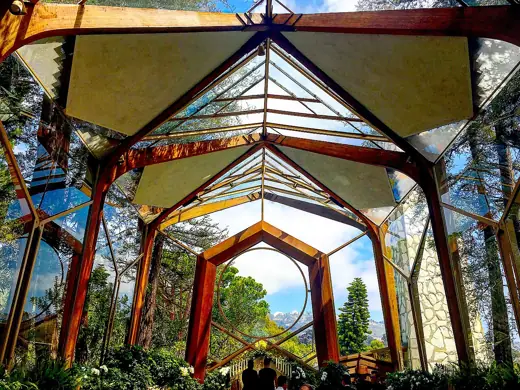
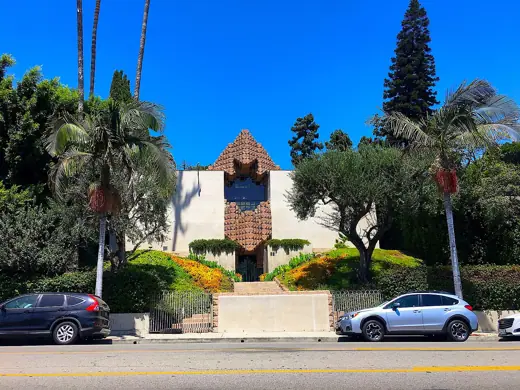
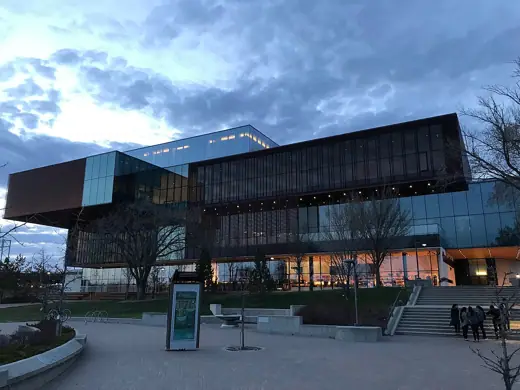
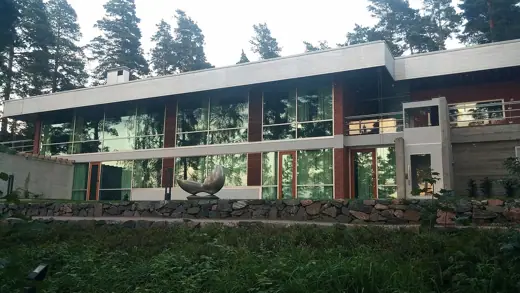
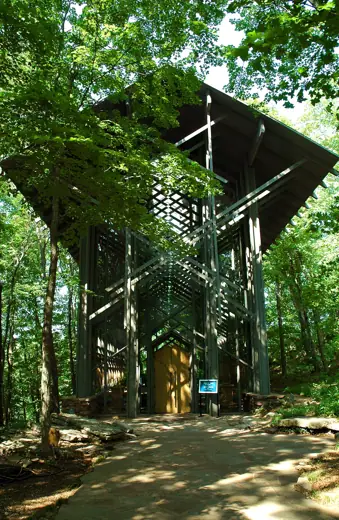
1/6 · Exterior · A beautiful melding of man and nature from Lloyd Wright, the son of the legendary Frank Lloyd WrightPhoto: Codera23 · CC BY-SA 4.0 · source2/6 · Exterior · Wayfarers Chapel in 2015Photo: Thudfinger · CC BY-SA 4.0 · source3/6 · ExteriorPhoto: Russ Allison Loar · CC BY-SA 4.0 · source4/6 · Exterior · Wayfarers Chapel, Rancho Palos Verdes, United StatesPhoto: Dmitry Kotov stubisdon · CC0 · source5/6 · Interior · Taken from the inside of Wayfarer's chapel at mid-afternoon in autumnPhoto: Prashila Amatya · CC BY-SA 4.0 · source6/6 · Interior · Wayfarers Chapel, interiorPhoto: Sitao Xiang · CC BY-SA 4.0 · source
Key featuresGlass enclosure lets the surrounding landscape define the sacred space; on a bluff above the Pacific.
About the building
Lloyd Wright, whose father was Frank Lloyd Wright, drew up Wayfarers Chapel, "The Glass Church", in the late 1940s; it was built from 1949 to 1951 for $25,000. The 100-seat chapel stood on a bluff over the Pacific in Rancho Palos Verdes as a memorial to Emanuel Swedenborg, an 18th-century scientist and theosopher, and was linked to the Swedenborgian Church. Breaking with the habit of masonry, Wright made it an indoor/outdoor structure almost wholly of glass, so that the landscape around it would define the sacred space. In 2005 it entered the US National Register of Historic Places, and in 2023 it became a National Historic Landmark. Extreme earth movement damaged it, and in 2024 it was dismantled and stored. The prospective new location is the Battery Barnes military site, roughly 1 mile (1.6 km) west of the original one.
Wayfarers Chapel, or "The Glass Church", is a disassembled chapel designed by Lloyd Wright and originally located in Rancho Palos Verdes, California. The chapel had unique organic architecture sited on a bluff above the Pacific Ocean. Affiliated with the Swedenborgian Church of North America, it served as a memorial to the 18th-century scientist and theosopher Emanuel Swedenborg. Built in 1949, the chapel was dismantled in 2024 and carefully stored after extreme earth movement had damaged the structure. In 2025, the chapel announced they were attempting to relocate to a new location in Rancho Palos Verdes.
As with many of Wright's buildings, the chapel features geometric designs and incorporates the natural landscape into the design. Wright departed from the tradition of using masonry in order to "achieve a delicate enclosure that allows the surrounding landscape to define the sacred space". In the 1950s, the chapel featured a hanging garden.
The Wayfarers Chapel was listed in the National Register of Historic Places in 2005 and was designated a National Historic Landmark for its architecture and landscaping in 2023.