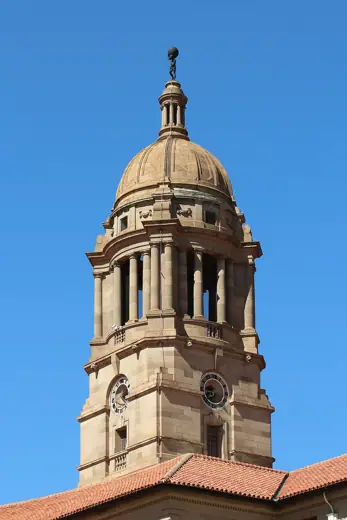
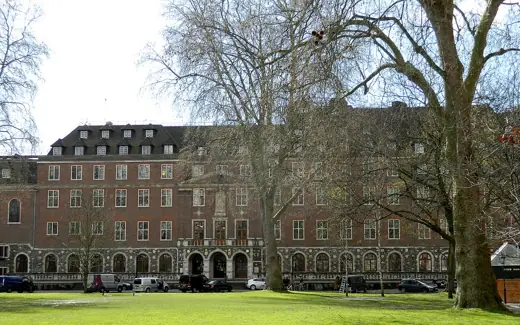
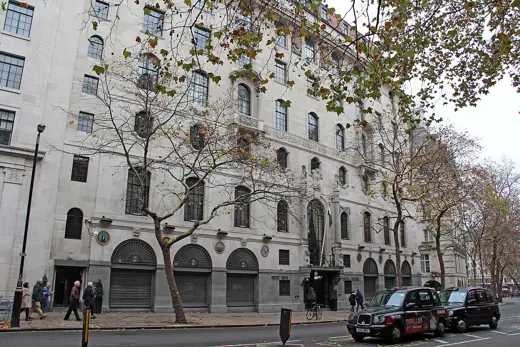
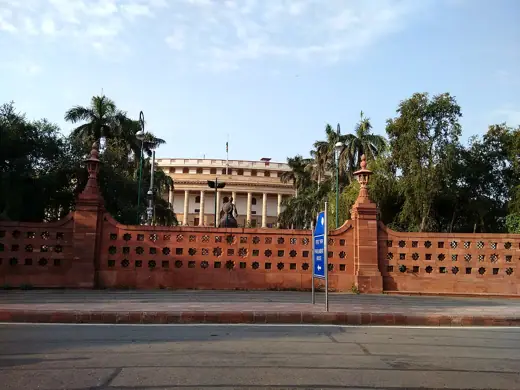
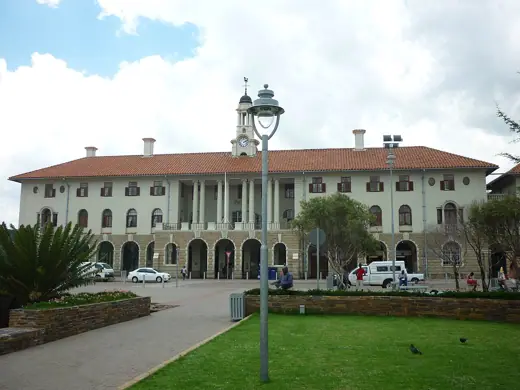
1/3 · Exterior · East tower of the Union Buildings, Pretoria, South AfricaPhoto: Bernard Gagnon · CC BY-SA 4.0 · source2/3 · Exterior · Veduta Union BuildingsPhoto: Pmk58 · CC BY-SA 4.0 · source3/3 · Interior · Union Buildings, Meintjieskop, PretoriaPhoto: Leo za1 · CC BY-SA 3.0 · source
Key featuresTwo office wings joined by a semicircular colonnade framing an amphitheatre above terraced gardens.
About the building
The Union Buildings are the official seat of South Africa's government and hold the offices of the President. Though outside central Pretoria, they occupy its highest point, and are a national heritage site. Herbert Baker designed them in the English monumental style, in light sandstone, and they stretch 285 m. A semicircular colonnade in the middle joins two side wings, meant to stand for the coming together of a people once divided. The site was a disused quarry, and its old diggings were used to form the amphitheatre, set with trees, ornamental pools, fountains, balustrades and sculptures. Baker used local materials wherever he could: granite quarried on the site and Buiskop sandstone for the courtyards. It took 1,265 workers three years to build, and it was finished in 1913 at a cost of £1,310,640, plus £350,000 for the land.
The Union Buildings (Afrikaans: Uniegebou) form the official seat of the South African Government and also house the offices of the President of South Africa. The imposing buildings are located in Pretoria, atop Meintjeskop at the northern end of Arcadia, close to historic Church Square. The large gardens of the Buildings are nestled between Government Avenue, Vermeulen Street East, Church Street, the R104 and Blackwood Street. Fairview Avenue is a closed road through which only officials can enter the Union Buildings. Though not in the centre of Pretoria, the Union Buildings occupy the highest point of Pretoria, and constitute a South African national heritage site.
These buildings, built from light sandstone, were designed by the architect Sir Herbert Baker in the English monumental style and are 285 m long. They have a semi-circular shape, with the two wings at the sides, this serves to represent the union of a formerly divided people. The clock chimes are identical to those of Big Ben in London. The east and west wings, as well as the twin-domed towers, represent two languages, English and Afrikaans, and the inner court was designed and built to symbolise the Union of South Africa. These buildings are considered by many to be the architect's greatest achievement and a South African architectural masterpiece.