




Culture & sport · Modernism
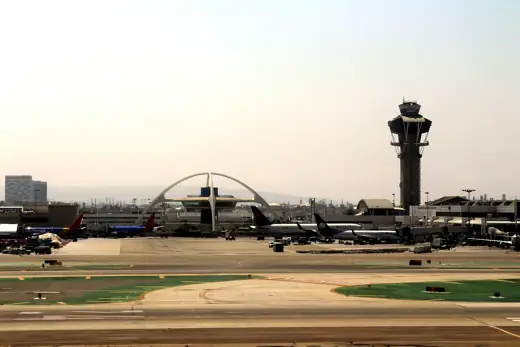
Theme Building
 byPereira & Luckman (William Pereira and Charles Luckman), with Paul Williams and Welton BecketLos Angeles, United States ↗
Key featuresWhite form like a flying saucer landed on four legs; dedicated June 1961.
About the building
Los Angeles International Airport's Theme Building first welcomed the public in 1961. The contract for its design went to Charles Luckman, his former partner William Pereira, and Welton Becket, who was based in Los Angeles; the work is credited too as a collaboration with Paul Williams. Luckman had been carrying the idea since 1953. In its first form it was to be much bigger, chiefly a glass dome holding the main ticket hall and terminals of LAX. A $50 million revamp of the entire airport had begun in April 1960. A revolving restaurant was planned to give diners a 360-degree view, but the turning mechanism soon cost too much to maintain, and the restaurant stopped moving.
Sources: Charles Luckman · William Pereira (Wikipedia)
More with sculptural formAll 769 →
Find more with
Sculptural form769 buildings →Structure as expression668 buildings →Geometry1061 buildings →Culture & sport614 buildings →Each opens every building that shares the idea.
Details
- Architect
- Pereira & Luckman (William Pereira and Charles Luckman), with Paul Williams and Welton Becket
- Year
- 1961
- Typology
- Culture & sport
- Movement
- Modernism
- Region
- Americas
Go deeper




See all 9 links


More · Culture & sportAll 614 →
Portrait: Los Angeles Times · CC BY 4.0 · source