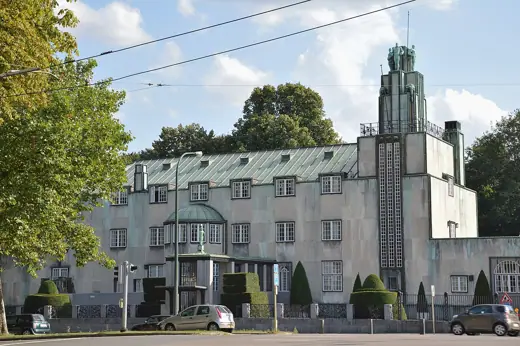
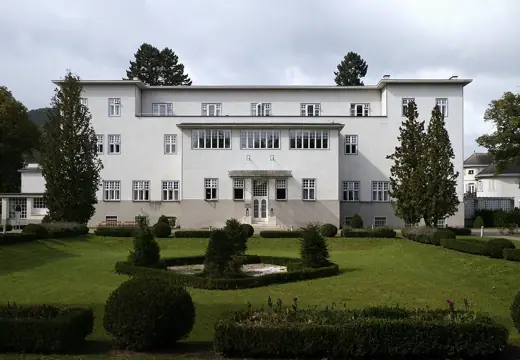
1/8 · Exterior · Palais Stoclet, avenue de Tervuren, n° 279/281 à Woluwé-Saint-PierrePhoto: Busoni · CC BY-SA 3.0 · source2/8 · Exterior · Palais Stoclet by Architect Hoffmann, World Heritage Site, BrusselsPhoto: PtrQs · CC BY-SA 4.0 · source3/8 · ExteriorPhoto: EmDee · CC BY-SA 4.0 · source4/8 · ExteriorPhoto: Josef Hoffmann · CC BY-SA 3.0 · source5/8 · Interior · Woluwe-Saint-PierrePhoto: Fred Romero from Paris, France · CC BY 2.0 · source6/8 · Interior · Woluwe-Saint-PierrePhoto: Fred Romero from Paris, France · CC BY 2.0 · source7/8 · Plan · plan élévation du palais Stoclet à Bruxelles - architecte HoffmanPhoto: Daniel baise · CC BY-SA 3.0 · source8/8 · Model · palais StocletPhoto: Carabain · CC0 · source
The Stoclet Palace (French: Palais Stoclet [palɛ stɔklɛ]; Dutch: Stocletpaleis [stɔˈklɛːpaːˌlɛis]), also known as the Stoclet House, is a historic mansion in Woluwe-Saint-Pierre, a municipality of Brussels, Belgium. It was designed by the Austrian-Moravian architect Josef Hoffmann for the Belgian financier Adolphe Stoclet, and built between 1905 and 1911, in the Vienna Secession style.
The Stoclet Palace was commissioned by Adolphe Stoclet, a wealthy Belgian financier and art collector, and his wife Suzanne. The Stoclets hired the 35-year-old Austrian architect Josef Hoffmann, who was a founding member of the Vienna Secession, a radical group of designers and artists established in 1897, to build them their own mansion. Stoclet had met Hoffmann while in Vienna to oversee the construction of a railroad, and he shared his avant-garde artistic inclinations. While Stoclet initially considered building the house in Vienna, he eventually settled on a site in Brussels.