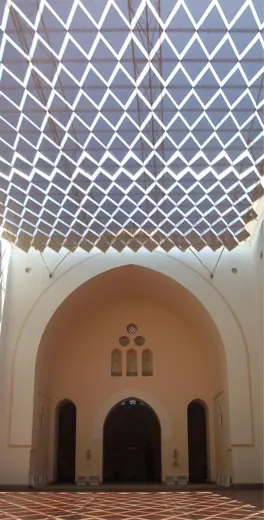
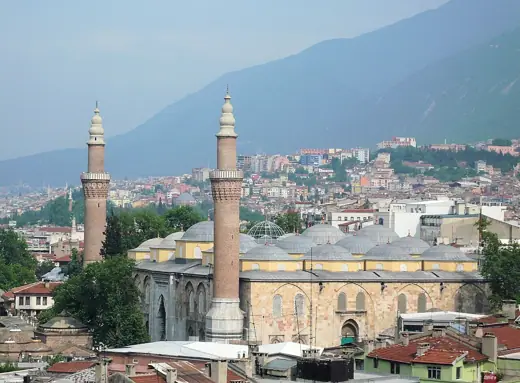
Key featuresBrick mosque with thick tapered walls in Tughlaq style and a hut-shaped roof; built 1442-1459.
About the building
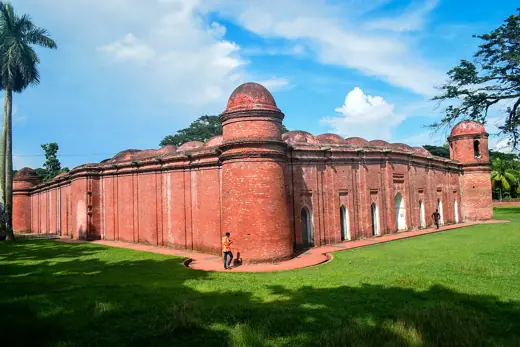
Khan Jahan Ali, governor of the Sundarbans, built this mosque in Bagerhat, in Bangladesh's Khulna Division, between 1442 and 1459. Part of Bagerhat's Mosque City, which UNESCO lists as a World Heritage Site, it is the biggest mosque in the country from the time of the Bengal Sultanate (1352–1576). It served for prayer and also as a madrasa and assembly hall. Despite the name, sixty columns carry 81 domes: 77 low ones in seven rows of eleven, plus one at each corner. The brick walls are unusually thick and tapered in the Tughlaq manner, and the hut-like roofline looks ahead to later styles. The oblong plan is 45.26 by 30.89 m outside and 37.57 by 23.22 m inside. The western wall has eleven mihrabs inside; ten are blind, and the central one projects on the exterior.
The Sixty Dome Mosque (Bengali: ষাট গম্বুজ মসজিদ) is a historical mosque, located in Bagerhat, in the Khulna Division of Bangladesh. It is a part of the Mosque City of Bagerhat, a UNESCO World Heritage Site. It is the largest mosque in Bangladesh from the Bengal Sultanate period (1352–1576). It was built by Khan Jahan Ali, the governor of the Sundarbans. It has been described as "one of the most impressive Muslim monuments in the whole of South Asia." It is situated approximately 4.8 kilometres (3 mi) from the main town of Bagerhat; and nearly 320 km (200 mi) from Dhaka. Despite its nomenclature, the mosque has 81 domes that are supported by sixty columns.
The Sixty Dome Mosque features unusually thick, tapered brick walls in the Tughlaq style and a hut-shaped roofline that anticipates later styles. Its oblong plan measures 45.26 metres (148 ft 6 in) by 30.89 metres (101 ft 4 in) externally, and 37.57 metres (123 ft 3 in) by 23.22 metres (76 ft 2 in) internally. There are 77 low domes arranged in seven rows of eleven, with an additional dome on each corner, bringing the total to 81 domes. There are four towers, two of four towers were used for the call to prayer (azaan).