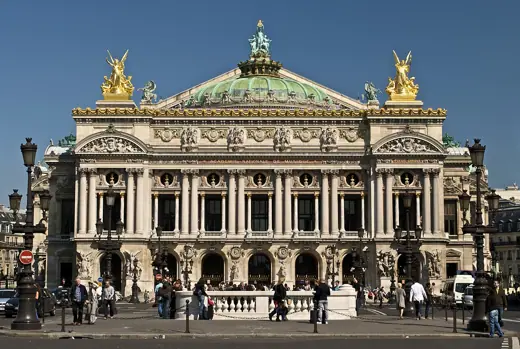
1/10 · Exterior · South façade of the Opéra Garnier in Paris, FrancePhoto: Peter Rivera · CC BY 2.0 · source2/10 · ExteriorPhoto: Philippe Chaperon / Adam Cuerden · Public domain · source3/10 · Interior · Opera House of Paris, the Palais Garnier's grand salonPhoto: Photograph: Eric Pouhier , Modifier: Rainer Zenz , Niabot (last modification) · CC BY-SA 4.0 · source4/10 · Interior · Ceiling over the Grand staircase in Garnier Opera or Palais Garnier , Paris, FrancePhoto: Diego Delso · CC BY-SA 4.0 · source5/10 · Interior · The Large Staircase of The Garnier Opera, in ParisPhoto: Benh LIEU SONG · CC BY-SA 3.0 · source6/10 · Interior · View from underneath the grand staircase with the Cave of Pythia at the right, Palais Garnier, Paris, FrancePhoto: Laurens R. Krol · CC BY 4.0 · source7/10 · Plan · Roof plan of the Paris Opera's Palais GarnierPhoto: Charles Garnier (1825–1898), architect Rebout, engraver Bordet, engraver · Public domain · source8/10 · Section · Transverse section at the auditorium and pavilions of the Paris Opera's Palais GarnierPhoto: Charles Garnier · Public domain · source9/10 · Section · Longitudinal section of the Paris Opera's Palais GarnierPhoto: Charles Garnier (1825–1898), architect · Public domain · source10/10 · Section · Transverse section at the front portico and loggia of the Paris Opera's Palais Garnier (looking north)Photo: Charles Garnier (1825–1898), architect · Public domain · source
Key featuresA Beaux-Arts opera whose grand staircase and foyers make a promenade as theatrical as the stage.
About the building
The Palais Garnier, also called the Opéra Garnier, is a 1,979-seat opera house in Paris's 9th arrondissement. Napoleon III's Second Empire launched a competition for a new opera house on 30 December 1860, and the building rose for the Paris Opera between 1861 and 1875 at the emperor's wish. Its eclectic style mixes Baroque, Palladian classicism and the Renaissance. Masonry walls carry the structure, with iron floors, vaults and roofs hidden from view. Seventeen kinds of material make up the façade, worked into multicoloured marble friezes, columns and statues, many showing Greek gods. Inside, corridors, stairs, alcoves and landings weave together so crowds can circulate and meet at the interval. A white marble ceremonial staircase, its balustrade in red and green marble, splits into two flights rising to the Grand Foyer.
The Palais Garnier (French: [palɛ ɡaʁnje] , "Garnier Palace"), also known as Opéra Garnier (French: [ɔpeʁa ɡaʁnje] , "Garnier Opera"), is a historic 1,979-seat opera house at the Place de l'Opéra in the 9th arrondissement of Paris, France. It was built for the Paris Opera from 1861 to 1875 at the behest of Emperor Napoleon III. Initially referred to as le nouvel Opéra de Paris (the new Paris Opera), it soon became known as the Palais Garnier, "in acknowledgment of its extraordinary opulence" and the architect Charles Garnier's plans and designs, which are representative of the Napoleon III style. It was the primary theatre of the Paris Opera and its associated Paris Opera Ballet until 1989, when a new opera house, the Opéra Bastille, opened at the Place de la Bastille. The company now uses the Palais Garnier mainly for ballet. The theatre has been a monument historique of France since 1923.