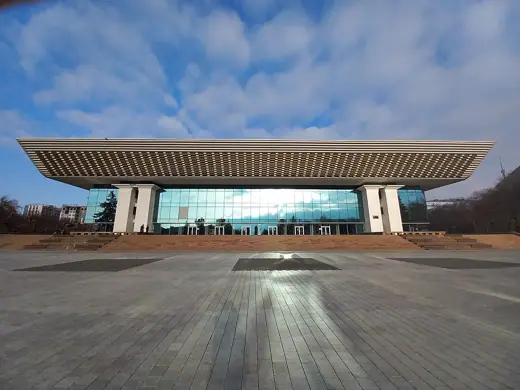
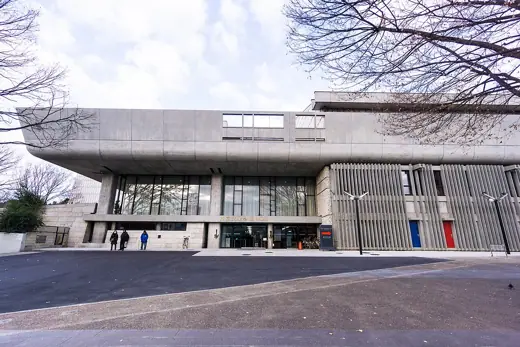
Key featuresConcert palace under a deep overhanging roof above a glazed front.
About the building
The Palace of the Republic in Almaty, by Nikolai Ripinsky, Leonid Ukhobotov and their team, stands on Abai Square, where Dostyq and Abai avenues meet. Built in 1970 under the name Lenin Palace of Culture, it opened during celebrations for the centenary of Lenin's birth. Its tent-like roof rests on eight concrete pillars, and since the outer walls stop short of it, the roof seems to float. A white chandelier hangs in the 13-metre-high main lobby, where national motifs appear in details such as the stair railings and marble floors. The stage is 48 metres wide and 18 deep; after a reconstruction the hall seats 2,567 instead of 3,000. In 1978 the Alma-Ata Declaration on primary health care was adopted here, and in 2008 the building was listed as a monument of republican significance.
The Palace of the Parliament (Romanian: Palatul Parlamentului), initially designed during Communist times as the People's House (Casa Poporului) or (less frequently used) the House of the Republic (Casa Republicii), is the seat of the Parliament of Romania, located atop Dealul Spirii in Bucharest, the national capital. The Palace reaches a height of 84 m (276 ft), is 92 m (302 ft) deep underground, has a floor area of 365,000 m2 (3,930,000 sq ft) and a volume of 2,550,000 m3 (90,000,000 cu ft). The Palace of the Parliament is the heaviest building in the world, weighing about 4,098,500 tonnes (9.04 billion pounds), and is the largest civilian administrative building in the world, the largest military administrative building being the yet larger US Pentagon (cf. List of largest buildings). The Independent described it as the third best building in the world, "hideous but also sort of impressive."
The building was designed and supervised by chief architect Anca Petrescu, with a team of approximately 700 architects, and constructed over a period of 13 years (1984–1997) in modernist Neoclassical architectural forms and styles, with socialist realism in mind. The Palace was ordered by Nicolae Ceaușescu (1918–1989), the president of Communist Romania.